
A sermon given on 17th April 2025 at Aldersgate Methodist Church for the Maundy Thursday Service.

Good evening, authentic missional community. It is both a privilege and a humbling honor to stand before you on this sacred Maundy Thursday. I want to begin by thanking our pastors and leaders for their unwavering support and for allowing me this opportunity to share God’s Word tonight. It is a blessing to serve alongside you all and to reflect together on the depth of Christ’s steadfast love—a love that transforms, redeems, and calls us into deeper fellowship with Him and one another.
Let us begin this time together with a word of prayer.
(Opening Prayer) Heavenly Father, we gather as one body, united in remembrance of Your Son’s steadfast love and heart of servitude. Tonight, as we reflect on the events of Maundy Thursday, may Your Spirit dwell among us, opening our hearts to receive Your Word and calling us to follow the example of Christ in love and service. Speak through me, Lord, and may everything we do here tonight glorify Your holy name. In Jesus’ name, we pray. Amen.
If you’ve ever tried finding a seat at a hawker centre during lunch hour, you’ll know — tables are where life happens. A simple table under a ceiling fan becomes the backdrop for everything: office banter over chicken rice, grandparents sharing kaya toast with their grandchildren, and uncles debating football scores over kopi-O.
The table has always been more than a place for food. In every culture, it is a place of connection and relationship. Whether it’s breakfast with parents, supper with friends, or reunion dinners during Chinese New Year, the table becomes a sacred space where laughter echoes, tensions soften, and bonds are strengthened. Even in moments of disagreement, coming to the table is often the first step toward reconciliation. The table represents fellowship, belonging, and shared life.
In the same way, the table, as described in the Bible, often carries profound meaning. It is a place of covenant and promise.
- Genesis 18: Abraham hosted three heavenly visitors under the great trees of Mamre. During this meal, God reaffirmed His promise to Abraham that Sarah would bear a son, despite their old age. The table can be a place where divine revelation and blessings unfold.
- 2 Samuel 9: David, honoring his covenant with Jonathan, sought out Mephibosheth, Jonathan’s son and Saul’s grandson. Despite Mephibosheth’s physical disability and being from the former royal family, David invited him to eat at the king’s table as one of his own sons. This table symbolizes grace and restoration.
- Psalm 78:19: During the Israelites’ journey through the wilderness, they doubted God’s ability to provide, asking, “Can God spread a table in the wilderness?” Despite their lack of faith, God provided manna and quail for them to eat. This table highlights God’s faithfulness and provision, even when His people grumble or doubt.
- In Psalm 23: David poetically describes the care, protection, and provision of the Lord as his Shepherd. The table is a powerful image of God’s blessings, despite opposition and challenges.
These tables collectively illustrate themes of hospitality, grace, provision, and fellowship, each reflecting aspects of God’s steadfast love.
On Maundy Thursday, yet another table takes center stage as Jesus gathers His disciples for the Last Supper. But this is no ordinary sedar (say-duh) meal. Around this table, Jesus does more than break bread—He reveals the depth of His love, His call to service, and His vision for a new kind of community.
Tonight, as we reflect on the topic that I have chosen: Fellowship at the Table, we will explore three powerful truths from the evening of Maundy Thursday:
- The Servant at the Table
- The People at the Table
- The Mandate from the Table
Our passage today is taken from John 13. If you would allow me, we will be reading parts of our passage as we move through the sermon.
The Servant at the Table
John’s Gospel uniquely devotes a significant portion of its narrative to the events of Maundy Thursday. Unlike the Synoptic Gospels (Matthew, Mark and Luke), John focuses less on the institution of the Lord’s Supper and more on the intimate moments and teachings Jesus shares with His disciples. Chapters 13 through 17 (five chapters), often called the Farewell Discourse, provide a detailed account of Jesus’ humility, love, and instructions, culminating in His prayer for unity among His followers.
And as we close the season of Lent tonight, it is in chapter 13 that we begin today’s reading. Hear the word of the Lord taken from the Gospel according to John 13:1-5
1 Now before the Feast of the Passover, when Jesus knew that his hour had come to depart out of this world to the Father, having loved his own who were in the world, he loved them to the end. 2 During supper, when the devil had already put it into the heart of Judas Iscariot, Simon’s son, to betray him, 3 Jesus, knowing that the Father had given all things into his hands, and that he had come from God and was going back to God, 4 rose from supper. He laid aside his outer garments, and taking a towel, tied it around his waist. 5 Then he poured water into a basin and began to wash the disciples’ feet and to wipe them with the towel that was wrapped around him.
This is the Word of the Lord, Thanks be to God.
The passage begins with a powerful and profound statement: “Jesus knew that his hour had come to depart out of this world to the Father”. This verse sets the stage for everything that follows. Jesus was fully aware that the moment of His greatest suffering was near—the betrayal by a close friend, the denial by another, the abandonment of all His disciples, and ultimately the agony of the cross. Yet, despite the weight of this knowledge, Jesus did not retreat into self-pity or isolation. He didn’t focus on Himself or hide from the horrors of what was to come. Instead, His attention was fully on His disciples—those He had walked with, taught, and loved throughout His earthly ministry.
John then adds a deeply moving detail in the farewell discourse: “having loved his own who were in the world, he loved them to the end”. This phrase reveals the nature of Jesus’ love for his disciples. The words “to the end” can be understood in two ways. First, it speaks of duration: Jesus loved His disciples till “the end”, which by measure of the divinity of Jesus Christ, represents eternity. His love never ends. Second, it speaks of the depth of His love. Jesus loved His disciples completely, perfectly, and steadfastly, demonstrating that true love is not conditional or fleeting—it is enduring and sacrificial. His love never falters.
We continue with verse 3 with yet an extraordinary declaration: “Jesus knew that the Father had put all things under His power, and that He had come from God and was returning to God.” These words confirm Jesus’ full awareness of His divine identity. He knew He held all authority over heaven and earth, that He was the Creator of the universe, and that His mission on earth was part of God’s eternal plan. Jesus didn’t need to prove anything to anyone. He had nothing to gain and nothing to lose. Jesus, fully aware of His divine power, didn’t use His authority to demand recognition, to seek status, or to enforce His will. Instead, He used His power to serve.
In that moment, Jesus did what no one expected and what no one else at the table would have volunteered to do. The washing of feet was the job of the lowest servant in the household. In the time of Jesus, dusty roads and open sandals meant feet were often dirty and unpleasant. In the culture of first-century Palestine, foot washing was not just a humble act; it was a demeaning one. It was reserved for the lowest-ranking servant in the household. No rabbi, teacher, or leader would ever stoop to this level. And yet, Jesus—fully aware of His divine identity—chose to kneel and serve in this way.
This act of washing feet redefined leadership in the Kingdom of God. The world teaches us that power is for self-promotion, control, and influence. But Jesus turned this idea upside down. True greatness, He showed, is found in humility and selflessness.
Paul captures this contrast beautifully in Philippians 2:6-7, where he writes that Jesus, “being in very nature God, did not consider equality with God something to be used to His own advantage; rather, He made Himself nothing by taking the very nature of a servant.”
The Gospel of John emphasizes this remarkable contrast between Jesus’ divine authority and His humble actions. Jesus’ humility was not a denial of His authority but an expression of it. He chose to use His divine power to lift others up, to meet their needs, and to show them what love in action looks like.
In our culture, power is often sought for personal gain; whether in our careers, relationships, or social status. We’re conditioned to believe that power means being served, not serving. But Jesus shows us a different kind of power.
- Jesus’ humility demonstrates that we don’t lose our dignity or strength when we serve others; instead, we reflect the heart of God. True power is not about control but about care.
- Jesus didn’t serve because He had to—He served because He chose to, out of steadfast love. Humility is not weakness; it is strength under control.
Jesus, the eternal Son of God, kneels before His disciples one by one. These were the same hands that co-created the stars and held the oceans in place, now gently washing the dirt and grime from the feet of His followers. This was not symbolic—it was real, tangible service.
Principle #1: Jesus’ love expresses itself through humility and selfless service.
The intimate moment at the Upper Room on the night of the Passover gives us a glimpse of the heart of God—a love that is steadfast, enduring, and selfless. Jesus didn’t just feel love; He demonstrated it through action, even in the most challenging circumstances. His example reminds us that steadfast love should not be dependent on our feelings or circumstances; it is a choice we make to reflect God’s character in how we treat others.
In our own lives, how do we respond when we face overwhelming challenges or feel the weight of difficult circumstances? It’s natural to want to retreat, to focus inward, or even to disconnect from others. But Jesus shows us a different way. Even in the face of unimaginable suffering, He chose to prioritize loving and serving those around Him. His example challenges us to ask: Are we willing to show love, even when it’s difficult? Are we willing to shift our focus from ourselves to those in need?
Jesus’ steadfast love calls us to live beyond our emotions and circumstances, to love even when it’s costly, and to serve even when it feels inconvenient. It is this kind of love—a love that endures, a love that serves—that transforms lives and reflects the heart of Christ to the world.
The act of washing his disciples’ feet shows us that Jesus’ love isn’t distant or abstract. It’s a love that stoops down into the messiness of our lives to cleanse and restore us. He doesn’t just love from afar; He comes near, humbles Himself, and meets us where we are. This act of foot washing was more than an act of humility—it was rooted in the foreshadow of what will come early the next morning. It foreshadowed the ultimate act of love that Jesus would soon demonstrate on the cross. In the same way that He stooped to wash the dirt from the disciples’ feet, He would soon lay down His life to cleanse humanity from sin.
If you think Jesus washing one’s feet is absolutely absurd… wait till you see what He is willing to do for you tomorrow. This is the extent of the depth of love that the servant at the table will go to show you how much He and His Father loves you.
Jesus’ love expresses itself through humility and selfless service.
The People at the Table
Our attention turns from the washer to the ones whose feet Jesus washed. We continue our reading in verses 12-17.
12 When he [Jesus] had washed their feet and put on his outer garments and resumed his place, he said to them, “Do you understand what I have done to you? 13 You call me Teacher and Lord, and you are right, for so I am. 14 If I then, your Lord and Teacher, have washed your feet, you also ought to wash one another’s feet. 15 For I have given you an example, that you also should do just as I have done to you. 16 Truly, truly, I say to you, a servant is not greater than his master, nor is a messenger greater than the one who sent him. 17 If you know these things, blessed are you if you do them.
Having taken over the role of being the lowest servant by washing the feet of his disciples, here, Jesus returns to His role as their Teacher and Lord. He asks the disciples a piercing question: “Do you understand what I have done for you?” On the surface, it may seem obvious—He had washed their feet. But Jesus wasn’t asking about the physical act; He was pointing to its spiritual and relational significance.
This question reaches across time and speaks to us as well. Do we truly understand what Jesus has done for us? Do we grasp the depth of His love, the humility of His service, and the grace that embraces us despite our flaws?
It is a well recorded fact that throughout the ministry of Jesus, his disciples often struggle to understand the depths of what Jesus is doing, or has done. Let me give you some examples:
- Jesus calming the storm. When a storm threatens their boat, the disciples panic and wake Jesus, accusing Him of not caring if they perish. After Jesus calms the storm, He rebukes them for their lack of faith. Despite seeing His miracles, they still struggle to comprehend His authority over nature, with the question: “Who then is this, that even the wind and the sea obey him?”
- Jesus must die. When Jesus asks His disciples who people say He is, Peter rightly declares, “You are the Christ, the Son of the living God.” However, immediately afterward, when Jesus begins to explain that He must suffer and die, Peter rebukes Him, showing that he does not yet understand the true nature of Jesus’ mission.
- Who is the greatest? The disciples argue about who among them is the greatest, showing that they still think in terms of earthly power and status. James and John (or their mother in Matthew’s account) ask Jesus to grant them seats of honor in His kingdom. They fail to grasp that Jesus’ mission is one of suffering and sacrifice, not earthly power.
- Son of Man. And my favorite example, throughout the Gospel according to Mark, not one person recognised the true identify of Jesus Christ, except the centurion at the cruxifixion.
Each of these examples demonstrates how the disciples, despite witnessing Jesus’ miracles and hearing His teachings, consistently struggled to grasp the full depth of His mission and identity. Despite spending significant time with Him, witnessing His miracles, and hearing His teachings firsthand, they frequently misunderstood His mission, His identity, and the nature of His kingdom.
More often than not, we are very much like the disciples. We may admire Jesus’ actions from a distance or acknowledge His love in theory, but how often do we pause to reflect on the full meaning of His true identity and sacrifice and what it calls us to do?
Jesus’ question, “Do you understand what I have done for you?” isn’t targeted just to the disciples in the upper room—it’s a question He asks each of us.
- Peter: Bold and passionate, overconfident often leading to failure, as seen when he denied Jesus three times despite his fervent promises.
- Andrew and Thomas: Struggled with doubt, disbelieving of Jesus’ miracles and in the case of Thomas, needing tangible proof to believe.
- James and John (Sons of Zebedee): Both ambitious and fiery but sought glory and recognition through status instead of the humility of true discipleship.
- Bartholomew (Nathanael): Exhibited prejudice, doubting that anything good could come from Nazareth
- Matthew: A despised tax collector, “betrayer” of his own people.
- Simon the Zealot: Strong political ambitions and zealous for Jewish independence.
- Judas Iscariot: Driven by greed and betrayal, chose personal gain over loyalty.
- James (Son of Alphaeus), Thaddaeus, and Philip: These quieter disciples represent those who faithfully follow Jesus and are often “forgotten”.
Do you see yourself as similar to one or more of these disciples? So, the same question Jesus asked, I repeat right now, “Do you, do we, understand what Jesus have done for us?” Do we truly grasp the depth of His love and the implications it has for our lives? Do we recognize that His act of service is a call for us to live differently?
Jesus wanted his disciples, and us, to see beyond the surface of the act. This wasn’t just about clean feet—it was about a transformed heart. When Jesus washed the disciples’ feet, He wasn’t just showing them humility; He was showing them their worth.
The disciples gathered at the table with Jesus on Maundy Thursday were by no means, even by human standards perfect, let alone by the standards of the Almighty God. Yet, Jesus invited this diverse group of men, each with unique personalities, strengths, and flaws to commune at the table with Him.
Jesus wanted to show that God’s love isn’t about finding the perfect people and gathering them at the table; it’s about transforming broken people and marking them for perfection.
Principle #2: The table of fellowship is open for all who want to be transformed by Christ’s steadfast love.
As we shine the spotlight on each of the disciples, we see how their stories mirror our own struggles and imperfections. Together, they remind us that the table of fellowship is for flawed people, invited into the transforming grace of Christ.
Perhaps the most difficult truth to confront is that Judas isn’t as distant from us as we might think. His presence at the table is a reflection of the human condition. Each of us, in moments of weakness, has chosen something else over Christ—whether it’s comfort, ambition, pride, or self-interest. Judas forces us to examine our own hearts and to recognize our need for the grace that Jesus freely offers.
Tonight, the table of the Lord is open for those who seeks to be transformed by Christ’s steadfast love. As you come forward for communion later, let us remember that Jesus invites us not because of who we are, but because of who He is.
This brings me to my last point.
The Mandate from the Table
Maundy Thursday is so named because of the mandate that Jesus gave at the Last Supper. A mandate to love. John 13:34-35 reads
34 A new [mandate] I give to you, that you love one another: just as I have loved you, you also are to love one another. 35 By this all people will know that you are my disciples, if you have love for one another.
At first glance, this mandate to love might not seem new. After all, the Old Testament already instructed God’s people to love their neighbor (Leviticus 19:18). The Jewish people understood the concept of love as part of their covenant relationship with God. So why does Jesus call this mandate new?
The answer lies in the nature of the love He calls us to and the foundation upon which it is built.
What makes this mandate new is not just the instruction to love, but the measure and model of love that Jesus gives:
- The Old Testament commanded love for one’s neighbor as yourself, but Jesus raises the standard— “As I have loved you, so you must love one another.”
- This love is no longer based on human effort or limited by self-interest. It is divine love—a love that sacrifices, serves, forgives, and endures, even when it is undeserved.
This is a new kind of love, modeled after Jesus Himself. This is not ordinary love; it is Christlike love, a love that forgives, washes feet, and lays down its life for others.
To fully understand the newness of this mandate, we must see it in the context of what Jesus had instituted that evening at the table.
During the Last Supper, Jesus took the cup, and as described by Paul in 1 Corinthians 11: Jesus took the cup, after supper, saying, “This cup is the new covenant in my blood. Do this, as often as you drink it, in remembrance of me.”
Jesus was establishing something entirely new—a new covenant between God and humanity, sealed not by the blood of animals (as in the Old Testament sacrifices) but by His own blood.
The Old Covenant, given through Moses, was built on laws and commandments—rules written on stone tablets. But the New Covenant, prophesied in Jeremiah 31, would be written on the hearts of God’s people.
Verse 35 concludes: By this all people will know that you are my disciples, if you have love for one another.
When people say that agape love describes the love that God has for us, that is only partially complete. On Maundy Thursday, Jesus mandated us to show agape love to one another. The Christian life is marked by the agape love that God shows to us, the apage love that we have for God, and the agape love that we have for each other. (Repeat)
This love is not just an instruction; it is a mark of identity. The evidence of our faith is not our beliefs, our membership status in AMC, our baptism, the depth of our understanding of theology, or even our participation—but our identity as Christians is how we love.
Principle #3: The world recognizes Christ through the love His disciples show to all peoples.
The early church took this command seriously. Under the New Covenant, they were known for their radical love. The Book of Acts records for us that the early church
- They shared all they had so that no one was in need.
- They welcomed outcasts—Jews and Gentiles, rich and poor, men and women, slave and free—all united by the love of Christ.
- They broke bread in their homes and ate together with glad and sincere hearts, praising God and enjoying the favor of all the people.
This is what sets them apart. And this is what should set us apart today.
AMC, as we aspire to be an Authentic Missional Community, are our relationships in the church marked by the unmistakable, unshakable agape love? Do we love in a way that proves we are His disciples—not just in words, but in action? Does our love invite others to the table, just as Jesus invited us?
Because we are under the new covenant, we don’t love by our own strength—we love through the power of the God through the manifestation of the Holy Spirit.
This means:
- We love sacrificially, putting others before ourselves.
- We love forgivingly, refusing to hold grudges or bitterness.
- We love unconditionally, extending grace even when it’s undeserved.
- We love practically, meeting the needs of those around us.
The table where Jesus issued this new commandment is also the table where He offered the cup of the new covenant. If we want to be an authentic missional community, we cannot separate the mandate to love from the sacrifice that made it possible. When we live out this mandate, we don’t just invite people to our tables—we invite them to the table of fellowship where Christ sits at its head.
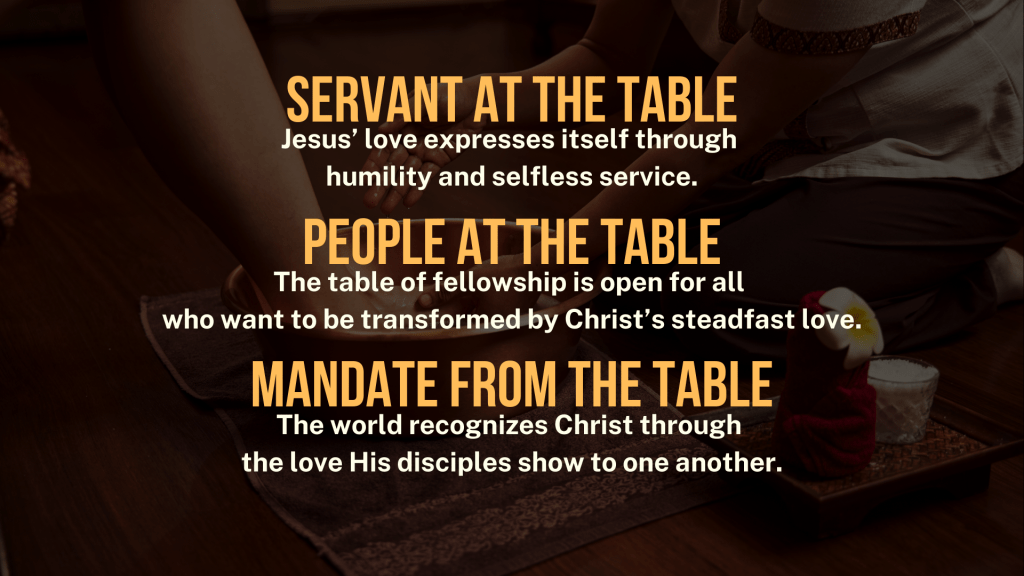
At the table on Maundy Thursday, Jesus assumes the role of a servant, washing the feet of His disciples—an act of humility that shows us the heart of true greatness. He then shares this intimate moment with a group of flawed and imperfect people—disciples who carry doubts, fears, and even betrayal in their hearts. Finally He gives them a new mandate: to love one another as He has loved them. Today as we gather at His table, let us remember the steadfast love of our Lord, for He has set an example for how we should go into the world.
The disciples left that table transformed, carrying the weight of Jesus’ words with them. And now, we are the ones seated at the table of fellowship. As we approach the table to receive communion, ponder as Jesus asks us today:
- Will you love as I have loved you?
- Will you allow the new covenant to shape your heart?
- Will you make love the defining mark of your discipleship?
Let us pray
(Closing Prayer) Heavenly Father, we come before You with hearts full of gratitude for the love You have shown us through Your Son, Jesus Christ. Tonight, as we reflect on the table of fellowship, we ask that You would transform our hearts. Lord, we confess that we are often like the disciples—flawed, weak, and struggling to love as You have called us to love. Yet, despite our imperfections, You invite us to Your table. You wash us clean, You embrace us with grace, and You call us into deeper fellowship with You and with one another. Help us, Lord, to truly understand what You have done for us. May Your love shape our words, our actions, and our relationships. Teach us to serve with humility, to forgive without hesitation, and to love unconditionally, even when it is difficult. May we become reflections of Your steadfast love in a world that so desperately needs to see it. Jesus, You have given us a new commandment—to love as You have loved us. May this love define our lives, our church, and our witness to the world. Let us not merely hear Your words but live them out daily, extending grace, embracing the broken, and drawing others to Your table of fellowship. Holy Spirit, empower us to be faithful in this calling. Strengthen us when we grow weary, soften our hearts when we resist, and guide us to walk in the way of Christ with boldness and humility. May the love we have received here not stay within these walls but overflow into every corner of our lives, so that others may see and know that we are Your disciples. In Jesus name, Amen.
 Joel Lai's Webpage