
A sermon given on 18th June 2023 for Aldersgate Methodist Church, Youth Ministry – Youthphoria. This is the script that I used. Enjoy.
Good morning Youthphoria, I want to thank your leadership for inviting me back, this time to continue the series on Galatians. Over the past weeks, if you were attentive during the sermons, you would have a glimpse of who the writer of Galatians is and his theology of how Jesus fits into the picture of salvation for Gentiles.
Paul wrote this letter to the churches in Galatia to address a dangerous heresy that had crept into their community. Some false teachers had come from Jerusalem and were persuading the Galatians to adopt a legalistic approach to salvation. They were telling them that in order for anyone to be saved, they needed to observe the same rituals and laws that are demanded of the Jews in the Mosaic law.
For example,
- Circumcision: The Judaizers insisted that Gentile converts must be circumcised according to Jewish law. They believed that this act was essential for salvation and membership in the covenant community.
- Observance of Jewish rituals and festivals: The Judaizers expected Gentile believers to observe various Jewish religious rituals and festivals, such as keeping the dietary laws, observing the Sabbath, and participating in Jewish festivals like Passover.
- Adherence to the Mosaic Law: The Judaizers taught that Gentile believers needed to obey the entirety of the Mosaic Law, including its moral, ceremonial, and civil aspects. They believed that salvation and righteousness before God were attained through strict obedience to the law.
In essence, the main message of these Judaizers is that in order for the Gentiles in the new churches of Galatia to be included in the larger body called the “children of God”, they have to live like the original “children of God” (i.e. Israel). Paul’s response to this false teaching is a clear and forceful defense of the true gospel, which teaches that we are justified by faith alone.
We will not be reading the entire passage now as I will be doing an exposition of the entire passage, so if you allow me, let us drive right in, and we will read the text as and when required.
I have three divisions from today’s passage:
- Impossibility of the law (vv. 1-5)
- Faith, not the law (vv. 6-14)
- Promise over the law (vv. 15-22)
Impossibility of The Law (Galatians 3:1-5)
Paul begins this chapter by expressing his concern that the Galatians have been deceived by false teachers who are preaching a message of legalism. Paul chides the Galatians for turning away from faith in Christ and instead relying on the law.
In Galatians 3:1, the apostle Paul addresses the Galatian believers with a sense of shock and disbelief, saying, “O foolish Galatians! Who has bewitched you? It was before your eyes that Jesus Christ was publicly portrayed as crucified.” This strong language emphasizes the seriousness of the situation and indicates. Paul is deeply troubled by the fact that the Galatians, who had initially embraced the gospel of grace, that the death and resurrection of Jesus saved them, were now turning to a different message brought to them by the Judaizers. Paul needed to set things straight.
He asks them, “Did you receive the Spirit by works of the law or by hearing with faith?” (Galatians 3:2). This question is crucial because it points to their own experience of salvation. The Galatians know that they had received the Holy Spirit, not through their observance of the Jewish law, but by hearing the message of faith in Christ and responding to it in trust. Yet somehow, they were reasoned out of their lived experience by the false teachings of the Judaizers.
He posed another question to the Galatians: “Are you so foolish? Having begun by the Spirit, are you now being perfected by the flesh?” (Galatians 3:3). Again, a rhetorical question! Paul’s point to the Galatians is that relying on human effort and attempting to achieve righteousness through legalistic observance of the law is both foolish and futile. Believers are being perfected by the Holy Spirit living in them, so why pursue another useless method of attaining perfection?
Paul then reminds the Galatians of the hardships they endured for their faith. He asks, “Did you suffer so many things in vain—if indeed it was in vain?” (Galatians 3:4). Paul’s argument is that the persecution that Paul, the apostles, the disciples, and the entire early church were facing is evidence of the authenticity of their initial faith in Jesus. Paul implies that it would be tragic for the Galatians to abandon the faith that so many had suffered for and turn to a works-based righteousness propagated by the Judaizers.
Paul continues by reminding them that the miracles and spiritual experiences they had witnessed, in their lives and the people around were not a result of their own efforts but of God’s work among them. He asks, “Does he who supplies the Spirit to you and works miracles among you do so by works of the law, or by hearing with faith?” (Galatians 3:5). Paul’s argument is clear: the spiritual blessings they had received were not earned through their adherence to the law but were freely given by God’s grace through faith in Christ.
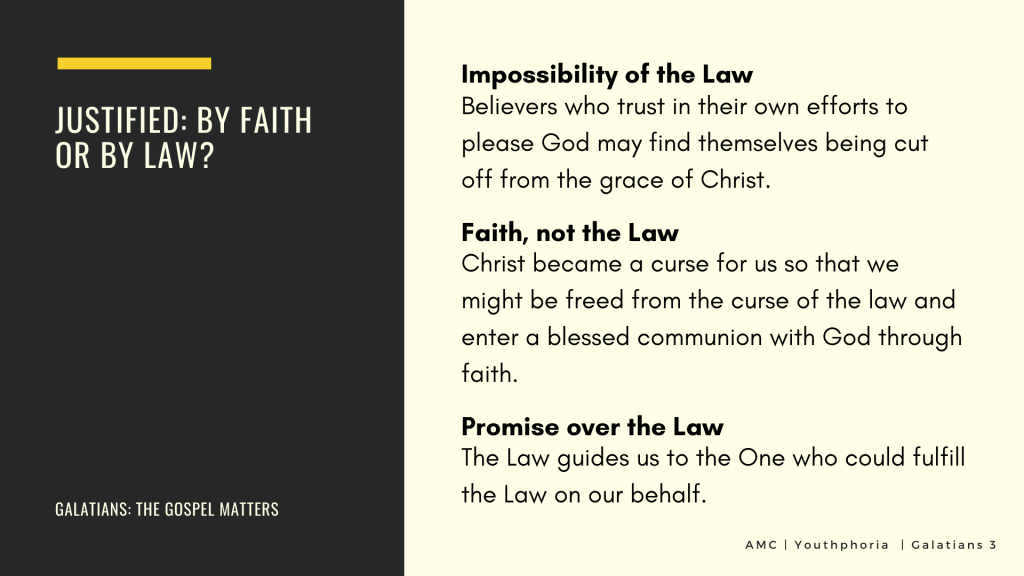
Principle 1: Believers who trust in their own efforts to please God may find themselves being cut off from the grace of Christ.
The central theme of this passage is the contrast between faith and works of the law. Paul emphasizes that true salvation and justification before God are not achieved through observing the Mosaic law but through faith in Jesus Christ.
Galatians 3:1-5 underscores for us the fundamental truth that salvation and the Christian life are not achieved through legalistic observance of the law but through faith in Christ. Paul challenges the Galatians to remember their authentic experience when they first believed, reflect on the work of the Holy Spirit in their lives, and reject the false teaching that would lead them away from the freedom and grace found in Jesus Christ. He reminds them that they received the Holy Spirit by faith, not by works of the law.
This is not an endorsement for you then to go out of this door to participate in all things illegal. The New Covenant is not “faith is all you need in life”. The New Covenant is “Faith is all you need to be justified”. So there is a role for the law in your life, but if you want to achieve righteousness by observing all the laws, it is impossible.
Faith, not The Law (Galatians 3:6-14)
How do we know that faith is all we need to be justified? At this point, it is instructive for us to understand 2 words:
- Justified / Justification
- Righteous / Righteousness
In simple terms, justification means that even though we have sinned and fallen short of God’s perfect standard, God, out of His love and mercy, offers us forgiveness and acceptance. Justification is a central concept in Christianity that describes our standing before God. It is the act of God declaring us to be righteous or right with Him.
What, then is righteousness?
Righteousness means being of standing or conformity with what is morally good with God and reflecting His character and moral standards.
Both justification and righteousness are gifts from God that enables us to have a restored relationship with Him and to live in a way that reflects His goodness and love to the world around us.
Paul goes further to argue that it was always God’s intention for us to be justified and made righteous through faith and not the law, he does so by turning to the example of Abraham.
He quotes from Genesis 15:6, which says that “Abraham believed God, and it was credited to him as righteousness”. God declared to Abraham that he would have descendants as numerous as the stars in the sky. Abraham believed God, and because of his faith, God considered him righteous. This means that Abraham was in a right standing with God, not because of his works or efforts, but because of his trust and reliance on God’s faithfulness. Abraham’s faith was not based on his own works or adherence to the Law, but on the promise of God.
This has huge implications not just for Abraham but also the descendants of Abraham and by extension, the Gentiles. Paul exerts, ”Know then that it is those of faith who are the sons of Abraham. In you shall all the nations be blessed. Those who are of faith are blessed along with Abraham” (Galatians 3:7-9). In other words, those who have faith in God, just like Abraham did, are considered true spiritual children of Abraham. Entry into God’s eternal family, so be a child of God is not determined by one’s blood heritage or adherence to Jewish customs and rituals. It is faith in God that defines a person’s relationship with Him.
You see, the essence of faith lies in trusting God’s promises, even when they seem impossible. Abraham believed God, and it was counted to him as righteousness. Similarly, when we place our faith in Christ, our righteousness is not earned through our actions or good deeds, but through our trust in the finished work of the cross.
Paul wants the Galatians, and by extension, us to know that even in Abraham’s time, God’s plan included the blessing and inclusion of all nations, not just the Jewish people. If we observe the sequence of events, Abraham was declared righteous years before instructions for circumcision and generations before the law was eventually given to the Israelites.
Therefore, the argument that the Judaizers bring concerning the need for Gentiles to practice circumcision and the observance of religious and ceremonial laws has no place in God’s grand plan of restoring mankind back to Him. Let us remember that our righteousness is not based on our works, but on our faith.
Paul goes on to explain why relying on the law for justification is a problem. He quotes, in Galatians 3:10, from Deuteronomy 27:26, which says that anyone who does not obey all the commands of the law is cursed. We have seen previously, and Paul is repeating it here that no one can perfectly fulfill the requirements of the Law. The Law, which was given by God, sets a standard of righteousness that none of us can attain through our own efforts. Therefore, relying solely on our works for salvation would ultimately lead to condemnation and separation from God.
Justification through the law requires perfect obedience. But since no one can completely comply to the entire Book of the laws, everyone is cursed. The Law does not provide a means of justification or salvation. But Christ redeemed us from the curse by becoming a curse for us on the cross. Paul reveals the glorious truth of redemption through Christ. He explains that Jesus took upon Himself the curse of the law, becoming a curse for us.
The good news is that Christ came to redeem us from this curse. Verse 13 says, ‘Christ redeemed us from the curse of the law by becoming a curse for us.’ Jesus willingly took upon Himself the punishment that we deserved. He became the sacrificial Lamb who bore the weight of our sins on the cross, experiencing the curse of sin and death on our behalf.
Quoting from Deuteronomy 21:23, he says, “Cursed is everyone who is hung on a pole.” Jesus’ crucifixion fulfilled this prophecy, as He bore the weight of our sins and the curse of the law upon Himself. It is, therefore, through faith in Christ, we are no longer under the curse of the law. Through His sacrifice, Jesus not only fulfilled the righteous requirements of the Law but also opened the way for us to be reconciled with God. He bridged the gap between our fallen state and God’s holiness, offering us forgiveness, restoration, and eternal life.
Principle 2: Christ became a curse for us so that we might be freed from the curse of the law and enter a blessed communion with God.
Through Christ’s sacrificial death, He became a curse for us, redeeming us from the curse of the law. If Christ has freed us from it, we should not go back to it.
Verse 14 tells us that the purpose of Christ’s redemption was ‘so that in Christ Jesus the blessing of Abraham might come to the Gentiles, so that we might receive the promised Spirit through faith.’ Through faith in Christ, both Jews and Gentiles are united and become partakers of the blessings promised to Abraham.
As believers, we are no longer under the curse of the Law, striving to earn our righteousness through our works. Instead, we have received the blessings promised by God, and the Holy Spirit dwells within us, empowering and guiding us in our journey of faith.
This truth is revolutionary! It means that our salvation and righteousness are not based on our own efforts or adherence to a set of rules. It is a gift of God’s grace, received through faith in Jesus Christ. We cannot earn it, but we can accept it with gratitude and humility.
Promise over the Law (Galatians 3:15-22)
Paul then makes the case that the law did not nullify the promise God made to Abraham. The promise was based on faith, and the law came later. Paul emphasizes that the Law, which was given to the Israelites through Moses, does not nullify or alter the previous promises made to Abraham. Instead, the Law served a temporary purpose until the coming of Christ. The law was given to reveal sin and to lead us to Christ, but it was not the means of justification.
Paul goes through a brief overview of the history of Israel.
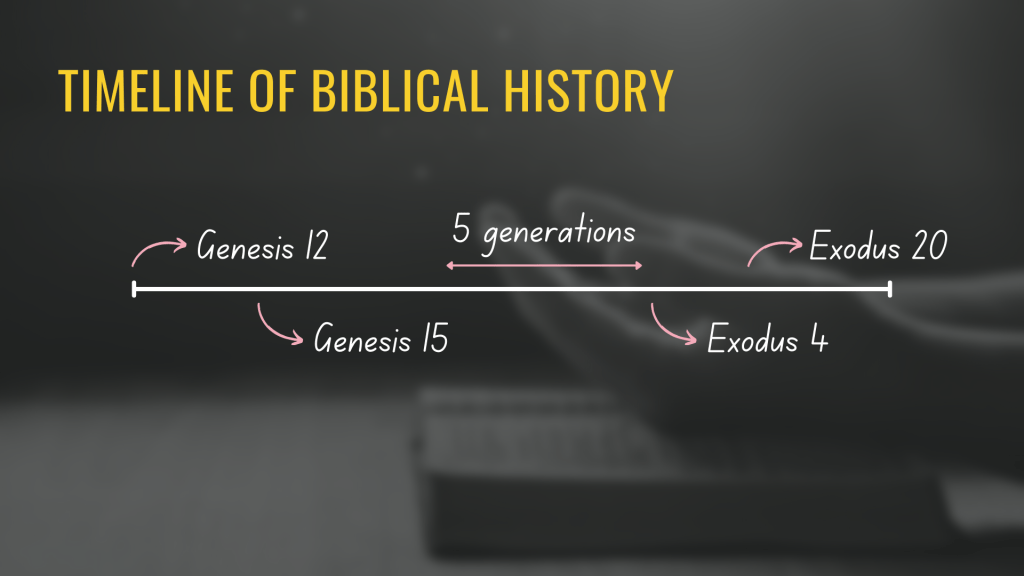
Through this short story-telling, Paul emphasizes that the Law, which was given to the Israelites through Moses, does not nullify or alter the previous promises made to Abraham. Instead, the Law served a temporary purpose until the coming of Christ. The law was given to reveal sin and to lead us to Christ, but it was not the means of justification.
Why, then, was the Law given? Paul tells us in verse 19: ‘It was added because of transgressions, until the offspring should come to whom the promise had been made.’ The Law acted as a temporary guardian, highlighting the reality of sin and pointing the way to the need for a Savior.
In verse 22, Paul encapsulates this truth: ‘But the Scripture imprisoned everything under sin…’ The Law made it evident that all people are under the captive power of sin and incapable of saving themselves. It served as a custodian, keeping the Israelites in check while they wait for the ultimate person that will release the same blessings that God had released to Abraham.
Principle 3: The Law guides us to the One who could fulfill the Law on our behalf.
The ultimate purpose of the Law was to lead us to Christ. It revealed our inability to keep God’s perfect standards and our need for a Redeemer.
And when the promised redeemer came some 2000 years ago, it is through faith in Jesus Christ, we receive the fulfillment of God’s promises. Verse 23 continues: ‘Now before faith came, we were held captive under the law, imprisoned until the coming faith would be revealed.’ The coming of Christ and the establishment of faith as the means of salvation released us from the bondage of the Law and the grip of guild that plagued mankind.
This truth is incredibly liberating! We are no longer bound by the impossible demands of the Law. Instead, we are set free by God’s grace through faith in Jesus Christ. Our righteousness and salvation are not based on our ability to keep the Law, but on the finished work of Christ on the cross.
 Joel Lai's Webpage