
A sermon given on 19th June 2022 for Aldersgate Methodist Church, Youth Ministry – Youthphoria. This is the script that I used. Enjoy.
Good morning Youthphoria, I thank Maverick/Abraham and the Youthphoria leadership for inviting me back to speak to you this Sunday. As a church, we are reading the Scroll of Leviticus, and throughout the past and next few weeks, the preaching across all services is on the Scroll of Leviticus. We reach a critically important chapter in Leviticus, for reasons you will hopefully find out by the end of the preaching today.
The chapter given to me today is Leviticus 16, the Day of Atonement. Much has been said and written about this day by various Torah and Biblical scholars, and if I were to go into detail, we could be sitting here all day. So what I would like to do, is to give us a flavour of the Day of Atonement in 4 parts. The names of the 4 parts may be a mouthful, but they are important for us to have a holistic overview of the Day of Atonement.
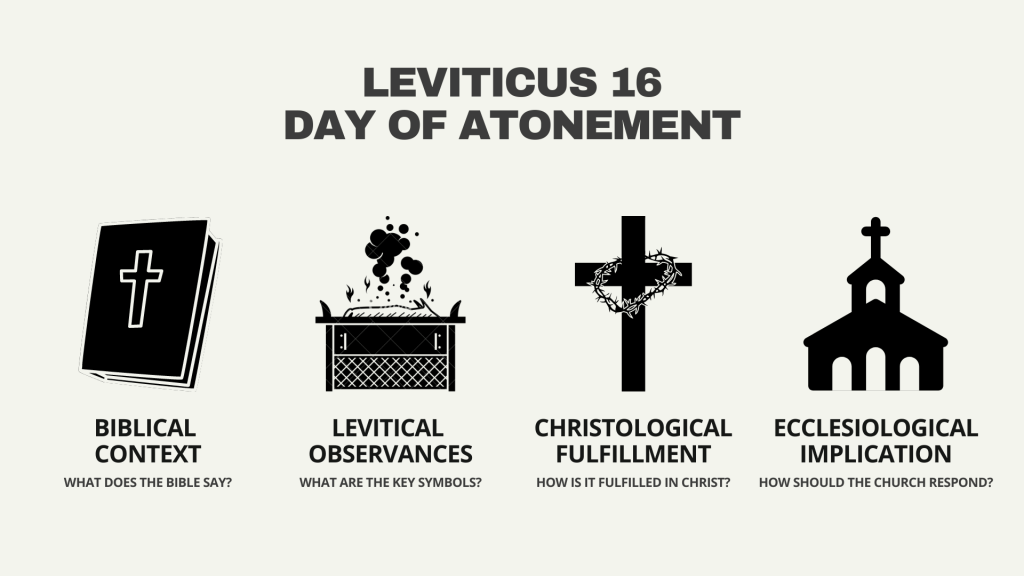
- Biblical Context: what does the Bible say?
- Levitical Observances: what are the key symbols in the OT practice of the Day of Atonement?
- Christological Fulfillment: how are the elements in the Day of Atonement fulfilled in Christ?
- Ecclesiological Implication: how does the church respond?
During the preaching, you will see small icons at the top right corner of the screen, in case you are lost along the way, refer to those icons so that you know how close I am to finishing the sermon.
In order to understand the Day of Atonement, we first need to go all the way back to the start of the Bible. In the last 3 sermons that I have preached here, I always draw us back to Genesis, because everything hinges on how God intended for mankind to live in relationship with Him.
All things were made perfect in the beginning in Genesis 1-2. We are told that God made all things, and at the heart of all of His creation is a place called the Garden of Eden. This was a garden planted by God in a place called Eden, where at the centre of this garden, is the Tree of Life. Adam and Eve were told that they were permitted to eat from this tree. And as long as Adam and Eve ate from this tree, they are never far from the presence of God. (Analogy of safe zone when playing catching)
But following the fall of man in Genesis 3, God’s masterpiece, humans, were eternally separated from God due to their sin. God placed a flaming sword and cherubim at the entrance to the garden, to deny mankind access to the Tree of Life.
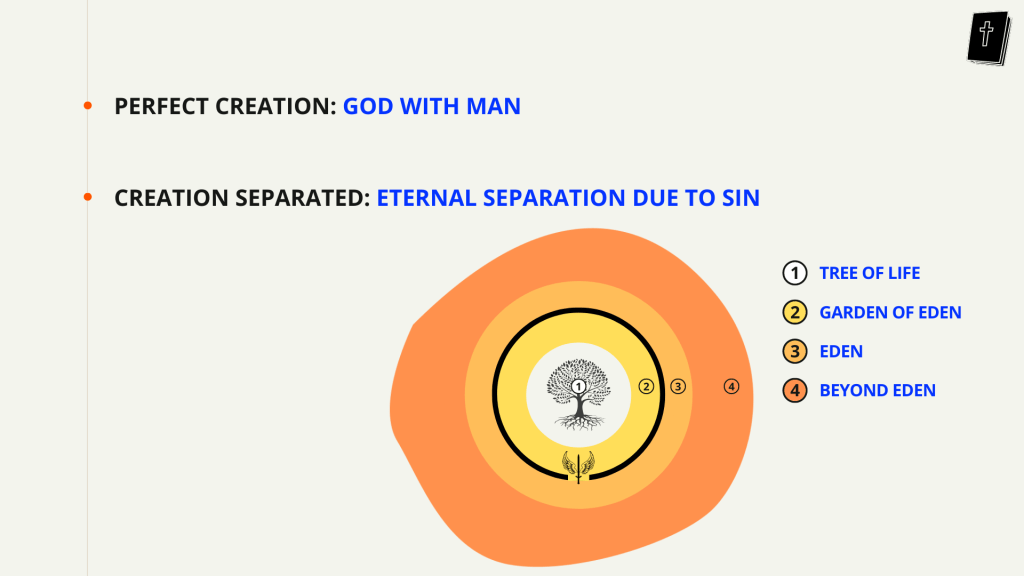
Let’s pause to think about this for a second. The Tree of Life is where God’s life-giving presence was, here on earth in the days of Eden. Very often we think of God’s presence as a good thing. It is good! But it is also very dangerous. When sinful things come into contact with the purity and majesty of God, God’s justice mandates that there will be death. So, for the sake of Adam and Eve, God had to block access to the tree. Otherwise, if Adam or Eve accidentally wanders too close to the tree, they will be struck dead. So right in Genesis 3, we already see a separation between man from God.
God’s plan to restore mankind back to Him was through a family called Abraham. In God’s covenant with Abraham, God promised that He will bless those who blessed Abraham and curse those who cursed him. God’s way of allowing all mankind to reach Him again, was through the blessing of Abraham and his family. We spent a good first half of the year studying Genesis, and that was where we left off earlier in the year.
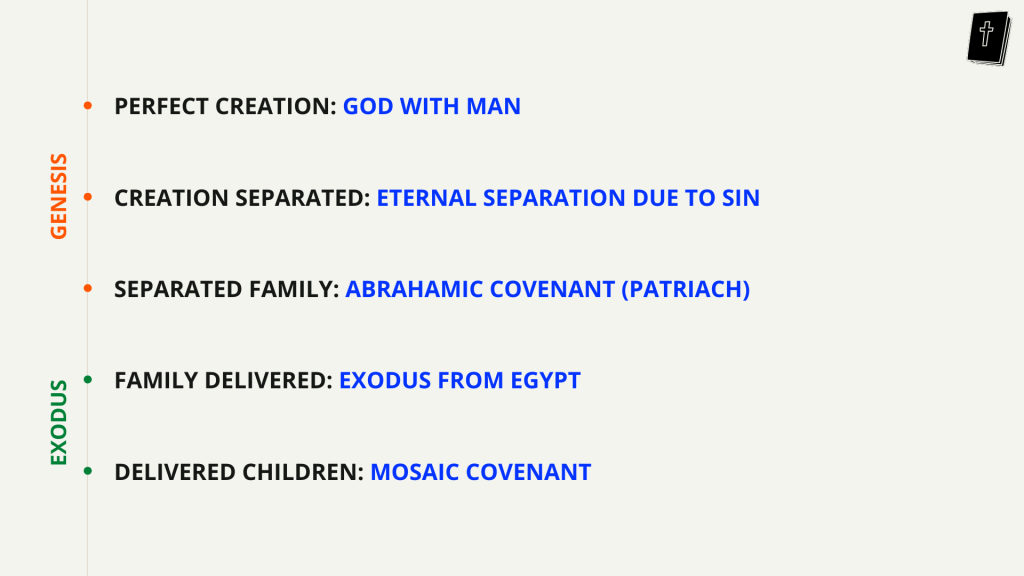
The Scroll of Genesis begins with perfect creation, but the fall of man led to creation separated. Thus, to restore man to Him, God chose a separated family from all others to be the blessing from which all will be blessed.
The Biblical narrative continues as we enter into Exodus, where the family of Jacob, a descendant of Abraham, was delivered from Egypt after 430 years in a foreign land. This family that was delivered from Egypt then went on to be the delivered children of God when God made a covenant with Israel through Moses. It is in the Mosaic covenant that God called Israel His firstborn son.
Since Adam and Eve were driven out of the Garden of Eden, we see God’s fleeting presence in and out of the story. In Genesis 1-2, His presence on Earth was well established in the Tree of Life. But following the fall of man, He appears and speaks to very few people. He never appeared to anyone else except a few VIPs in the Biblical narrative. This all changed when God made a covenant with his delivered children, Israel. As part of the covenant, God also decided to permanently live among His children. How? through the moving artefact called the Ark of the Covenant, that resides in the Tabernacle.
At end of the Scroll of Exodus, God instructed Moses to build a Tabernacle, so that God can dwell among His people. BUT! Israel is still sinful, so God still had to be separated from Israel, His presence residing in the Ark of the Covenant, was kept away from the entire Israelite camp in the Holy of Holies of the Tabernacle.
While Israel was allowed in the outer courts, that was the closest they could get to God. Just like Genesis 3, where Adam and Eve were kept out of the Garden; at the end of Exodus, we see that Israel was kept out of the Tent.
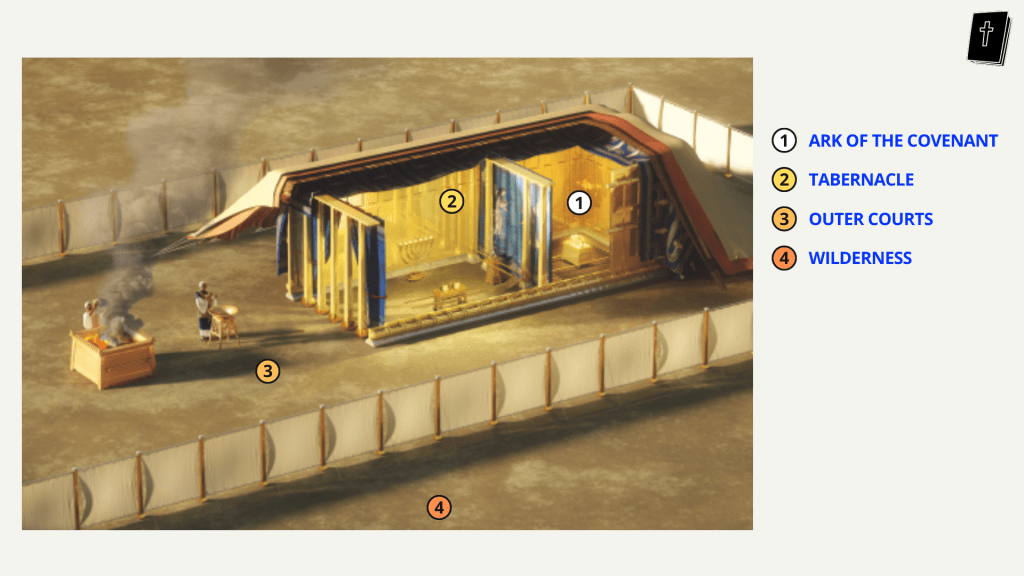
The Scroll of Exodus ends with this Exodus 40:35 “Moses could not enter the tent of meeting”. And Leviticus, the Book we are studying begins with “God spoke to Moses from the tent of meeting”. The very person, whom we would have thought could at least speak to God in His presence, was barred from entering the Tabernacle. While we expect closeness, we get separation. Thus, herein lies the problem.
Mankind still suffers from the Holiness problem! In God’s perfect creation, God had intended for Him and man to live together in close proximity. Yet, because of the sin of man, God is intentionally keeping us at a distance, for our own good. This is the holiness problem.
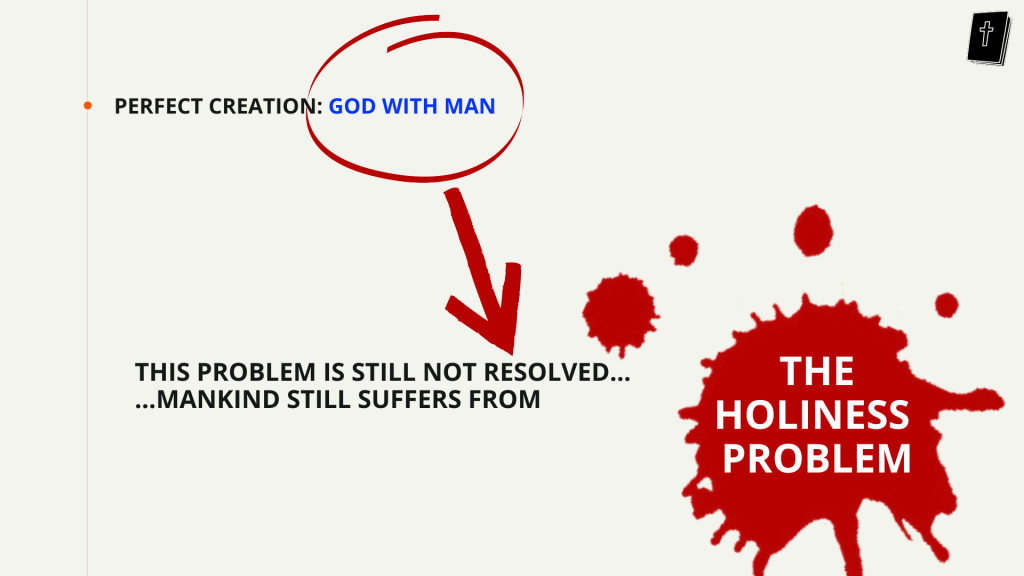
We like to think of holiness as “being good”. If you are good (sinless) = you are holy, if you are bad (sinful) = not holy. And we all fall in the spectrum of sinless vs sinful. If that’s the definition of holiness that you have, then we need to think hard if that is correct. Firstly God’s definition of sin is strict! There is no spectrum. Secondly, if holiness is about being sinless, no one can ever be holy. And yet God instructed Israel in Leviticus to be Holy for I am Holy. Holiness, according to God is something that must be, and can be achieved. So holiness is slightly more intricate than sin vs sinless. Holiness is about closeness. When God says “be holy for I am holy”. God is in fact saying, come close to Me, for I have come close to you on earth. God has initiated the process of coming to earth, to permanently reside on earth among His chosen people – Israel. So God is now inviting them to come close to Him.
“Speak to all the congregation of the people of Israel and say to them, You shall be holy, for I the LORD your God am holy.”
Leviticus 19:2
Holiness is closeness, not sinless. But in order to be close, God will need to institute a way for Israel to come close.
It is with this Biblical context, that we now enter the Levitical observances. Leviticus is a Book that helps us to answer a “very simple” question: How can sinful people come close to the gift of God’s presence on earth? In short, how can sinful people be holy, just as God is holy?
Leviticus is really a guide to solving the holiness problem. How? in three ways: Rituals, Priesthood, and Purity. I will not dive too deep into all of them because they should have been covered in the preaching before me, and more will come after me. But I want to give us a flavour of how the Day of Atonement fits into the Levitical Observances.
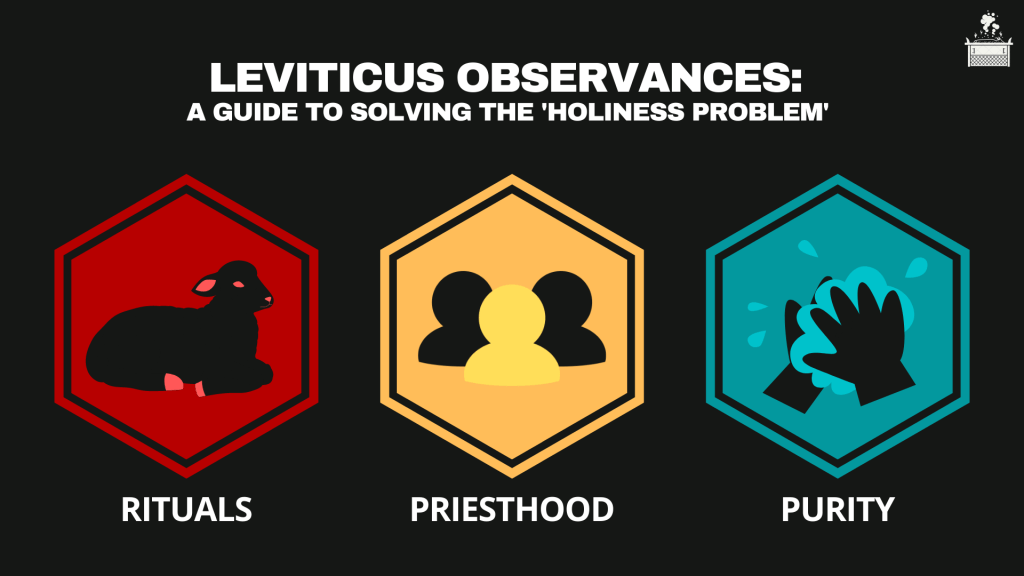
The Book of Leviticus starts and ends with rituals. Chapters 1-7 on the ritual sacrifices, and Chapters 23-27 on ritual feasts of celebration and contemplation. First seven chapters on all the sacrificial rituals that Israel have to observe, and the final five chapters the observance of seven ritual feasts to remember the character of God.
The five sacrifices can be split into two categories, thanksgiving and forgiveness. The thanksgiving offerings are, as the name suggests, a thanksgiving to God for his providence of sustenance and relationships, and the forgiveness offerings, as the name suggests, are to seek God for forgiveness. Of all these offerings, I want to highlight the “sin offering”. While this offering is not more important than the rest, the sin offering is one of the key rituals that is also conducted on the Day of Atonement.
Alongside the ritual sacrifices are the ritual feasts. There are seven of them, and the one that we want to focus on is the Day of Atonement, which I will get to in a bit. So, the RITUALS occupy the outer sections of the Book of Leviticus. The inner chapters, Chapters 8-10, and Chapters 21-22 are narratives and instructions on the ordination of the sons of Aaron as priests, and also a set of rules for the qualification of the priests. As we work our way closer to the middle of Leviticus, we then approach the purity laws. Chapters 11-15 talk about ritual purity, and Chapters 17-20 on moral purity.
For ritual purity, God laid out for Israel a list of laws pertaining to the type of food that Israel can and cannot eat. Also in these chapters are rules on what needs to happen when Israel comes into contact with impure things. These laws are not there to make life difficult for Israel, rather, these laws are there for God to prove a point about purity. Purity is all about being meticulous. Purity is all about obedience. Coming into contact with these things doesn’t mean that Israel had sin, they just touched unclean things. So they have to perform the appropriate rituals to become pure again. If Israel can be meticulous and obedient in the way they deal with impurities, they will understand the heart of God and how God views the impurity that afflicts mankind – sin.
Chapters 17-20 then go on further to discuss the moral purity of Israel. Israel is expected to care for the poor, pursue sexual integrity, and uphold social justice, both to fellow Israelites, and also to foreigners living in their midst.
As we work our way through Leviticus, we read about rituals, we read about the priesthood, and we read about purity. But there is a chapter that ties all these things together, and that chapter is Leviticus 16. At the heart of the chiastic structure of Leviticus is Leviticus Chapter 16, which is on the Day of Atonement.
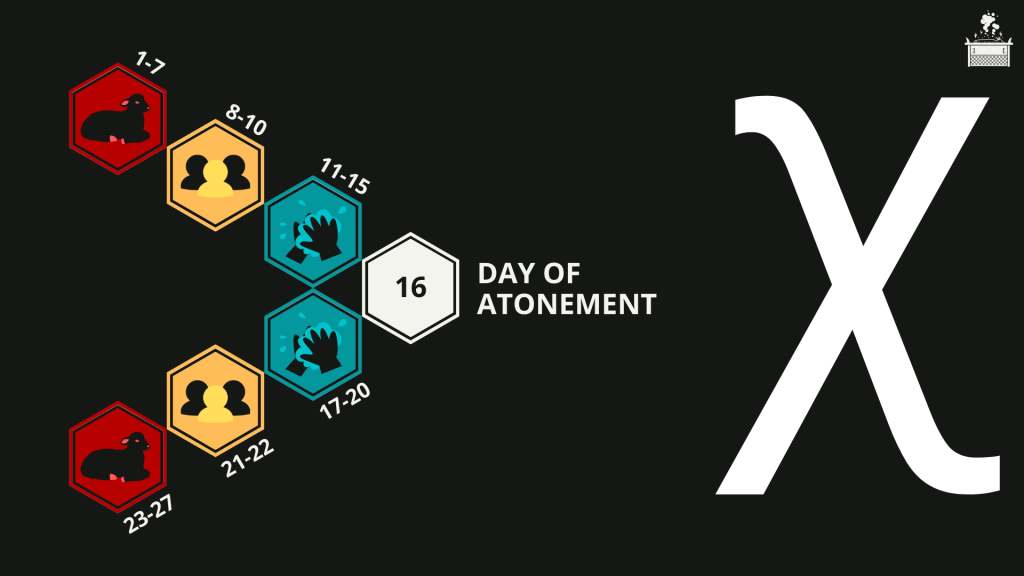
The Day of Atonement is the heart of Leviticus, which ties in all the other elements of Leviticus. Leviticus 16 describes for us a ritual feast commemorated once a year on the tenth day of Tishrei, Yom Kippur, or the Day of Atonement.
So even before we read Leviticus 16, we already have a huge catalogue of context and observances we need to have at the back of our minds.
- Genesis and Exodus describe for us the Holiness problem – while God is here on earth with us, man still cannot come close to God, as they originally were in the Garden of Eden.
- Leviticus describes the way to get close to God through practising rituals, mediating through the priesthood, and pursuing purity, and it all ties together on the Day of Atonement.
With this, let us read Leviticus 16:7-10

On the screen, you see 3 highlighted phrases: He, referring to Aaron the high priest, a goat, which will be slaughtered as a sin offering, and another goat, which will be released as a scapegoat.
Notice how all three elements of Leviticus can be found in just these 4 verses describing the Day of Atonement. The sin offering represents the rituals, the high priest, represents the priesthood, and lastly, the scapegoat represents the atoning purity.
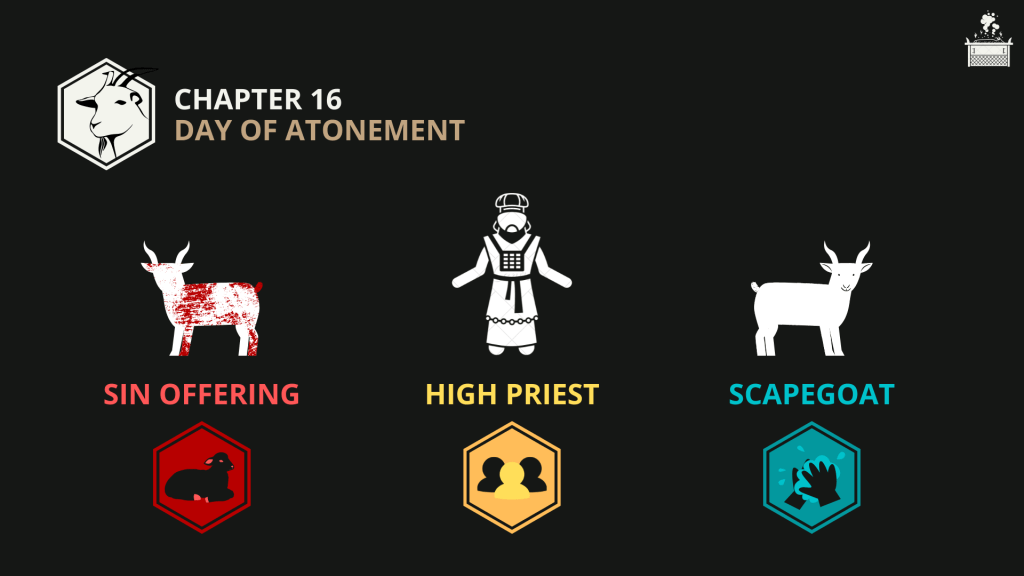
Let us look at each of these symbols one by one, and as we look at them in isolation, I will bring in other passages from Leviticus 16 and 17, which give us further details on the characteristics of these symbols.
We start with the high priest. Leviticus 16:2 tells us “Tell your brother Aaron (this is God speaking to Moses) that he is not to come whenever he chooses into the Most Holy Place behind the curtain in front of the atonement cover on the ark, or else he will die.” The passage goes on in verse 3 to say “This is how Aaron is to enter the Most Holy Place: He must first bring a young bull for a sin offering and a ram for a burnt offering.”
Before the rituals of the Day of Atonement even begin, God instructs Moses to tell his brother, Aaron, the high priest, that before you atone for the sins of Israel, you must first atone for your own sin.
The Day of Atonement begins with the preparation of the priesthood. The high priest must make sure that he himself is without sin before he can mediate between God and his people.
Once the priesthood is ready, then begins the atonement of sins for Israel. The verse we read earlier tells us that 2 goats are chosen. Described in other parts of Leviticus, is the condition of the two goats. These two goats must be without blemishes or defects. A lot is drawn for which goat becomes the sin offering, and that goat is then prepared as a sin offering.
Leviticus 16:15 records for us that Aaron “shall then slaughter the goat for the sin offering for the people and take its blood behind the curtain…”. This is the curtain that separates the Holy of Holies from the Tabernacle.
Well, that’s a bit unfair. Why should a goat, without any wrongdoing be used as a sacrifice for the atonement of humans’ sin? But that was how God designed the sin offering to be. It is a gift from God to us, that we should not die, but something else dies in our place.
Leviticus 17:11 tells us, that the life of a creature is in the blood, and it is the blood that makes atonement for one’s life. This blood, this life, is taken into the Holy of Holies because that is where God is. This blood, this life is closer to God’s presence than any other Israelite would ever be. Even on the Day of Atonement, when Israel is meant to be declared without sin, they still cannot get close to God, at least not as close as the lifeblood of the slaughtered goat.
The other goat, the scapegoat has another purpose. Aaron is told, in Leviticus 16:21-22 “to lay both hands on the head of the live goat and confess over it all the wickedness and rebellion of the Israelites—all their sins —and put them on the goat’s head. He shall send the goat away into the wilderness… The goat will carry on itself all their sins to a remote place…”
This laying of both hands has a deep theological significance which I do not have time to go into today, but to give a few examples: When Moses appointed Joshua to be the representative leader of Israel, who will take over his place, there is this laying of both hands. In the NT, when Paul commissioned Timothy to be a representative of him to lead the church in Ephesus, there is this laying of both hands. So laying of both hands is synonymous with declaring a representative.
By laying hands on the goat, the high priest commissioned the goat to be the representative of the tribes of Israel. Notice that the laying of both hands is on the scapegoat, the goat that stays alive, not the slaughtered one. So the blood of the slaughtered goat is NOT defiled, and can be brought into the Holy of Holies. Instead, the sins of Israel are transferred to the scapegoat, which is then exiled, almost certain to die.
So this scapegoat represents the Israelites being exiled from the presence of God. Notice how this idea of holiness is revisited again. The scapegoat is a representative that is sent away so that Israel does not need to be exiled, and so that Israel can stay relatively close to the presence of God. So that Israel can remain in holy proximity to a holy God.
The day of atonement starts early in the morning, and ends at 6pm in the evening. After almost a full day of work, we revisit the high priest, while Israel makes their way back to their own tents, Aaron’s work is not done. Leviticus 16:23 tells us that Aaron needs to bathe himself, perform another burnt offering for himself and for the people, and then make another sin offering on the altar.
Let us summarise what we have so far. We have the sin offering, which is the substitution for the sinner, through its death, its lifeblood can be brought close into the presence of God. We have the high priest who is the mediator between the separated sinner and a present God. And we have the scapegoat, who represents Israel’s sin, exile from the camp so that Israel can continue to remain in holy proximity to God.
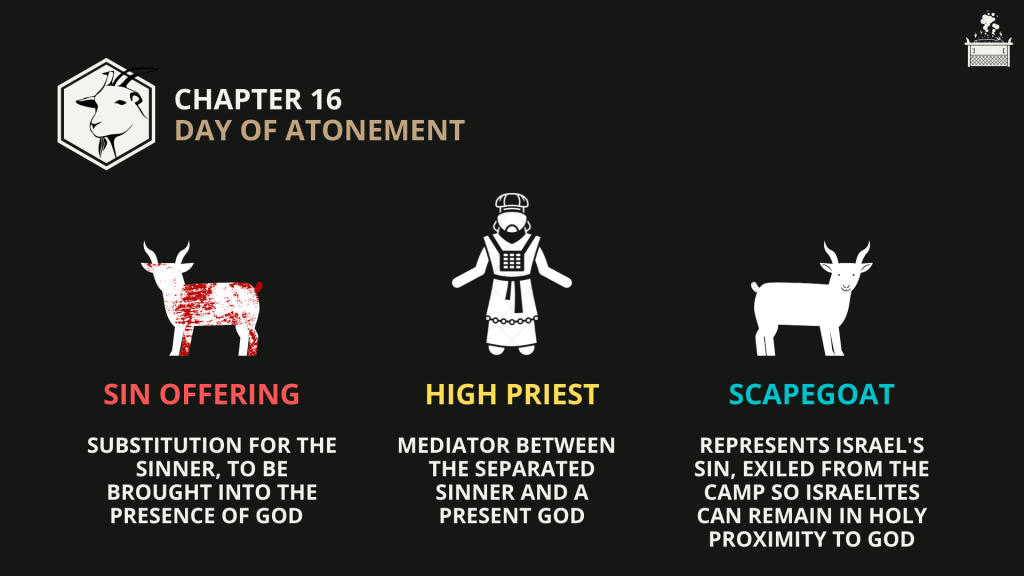
We have all these symbols, but we want to answer the important question: What is the point of the Day of Atonement?
Remember that Exodus ended and Leviticus began with the separation of Moses from God? Moses, whom we expect should be able to speak to God in close proximity, in fact, still finds himself standing outside of the tent speaking to God. Let’s see what happens at the end of Leviticus.
Numbers 1:1, the first verse after the end of Leviticus tells us “God spoke to Moses in the tent”. It is through the description and practice of the rituals, the mediation of the priesthood, and the strict compliance with purity that now enables Moses to be in the tent, speaking to God.
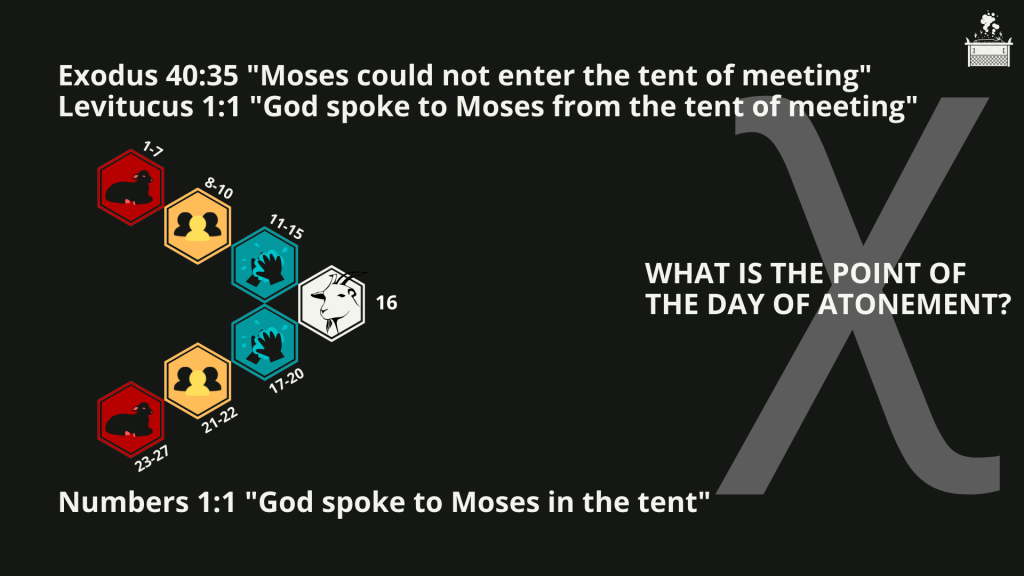
And right at the centre of Leviticus is the Day of Atonement that ties it all together.
The Day of Atonement shows God’s grace to Israel by providing a way for people to live in his presence. In short, Leviticus shows Israel how to be holy, just as God is holy. It is through Leviticus that Israel can theoretically, and practically live close to God, in the presence of their god.
Now, if I were to end the sermon here, we are living in history. If you look at the modern church calendar, you do not see the Day of Atonement as one of the days that is marked in the church calendar. So something must have happened between the Old Testament Levitical observances and today. And I think we all know what I am hinting at, which brings me to the next section: The Christological Fulfillment.
You see, the Levitical observance in the Scroll of Leviticus is not the complete story. The Day of Atonement contained only the shadow of future good things, but not these things themselves. Hebrews 10, says “We have been made holy through the sacrifice of the body of Jesus Christ once for all. Day after day every priest stands and performs his religious duties; again and again he offers the same sacrifices, which can never take away sins. But when this priest had offered for all time one sacrifice for sins, he sat down at the right hand of God… For by one sacrifice he has made perfect forever those who are being made holy.”
Jesus Christ is our great High Priest. He is the High Priest over all high priests. While the Levitical high priests have to first atone for his sin through the burnt and sin offerings, we are told that Jesus is without sin. While the Levitical high priests have to continue working after the sin offering is offered and the scapegoat released, our great High Priest ascended into heaven and sat at the right hand of the Father because nothing else needs to be done.
Not only was Jesus the great high priest, but Jesus was also the sin offering and scapegoat. The verse in Hebrews 10 tells us that Jesus Christ is the one sacrifice that we need. He is the one perfect sacrifice.
The first thing that Jesus said when He was on the cross, was “Father, forgive them, for they do not know what they are doing.”. Of all of the things Jesus said, it is noteworthy that the first sentence on that cross was a declaration of forgiveness.
By this declaration, no longer do we need sacrifice after sacrifice. By this declaration, no longer do we need atonement after atonement. By this declaration, no longer do we need Yom Kippur after Yom Kippur. We just need Jesus Christ to declare “it is finished”.
As a people under the New Covenant, there really is no mandate or reason for us to observe the Day of Atonement. There is a lot that we can learn from the Levitical Observances of the Day of Atonement and we should absolutely study them in light of the New Covenant, but there is no requirement for us to observe the Day of Atonement in the same vein as the Jews do. But before we simply brush it aside and naively claim that the reason we do not observe the Day of Atonement is due to Jesus’ sacrifice, we ought to think deeper.
Saying Jesus became a “sacrifice” for us so that we no longer need to make earthly sacrifices relegates His death and resurrection to simply a matter of convenience and would indicate that if we did restart the proceedings of the Day of Atonement, we could accomplish the same ends without Jesus.
In an earlier verse in Hebrews 10:4, it tells us that “It is impossible for the blood of bulls and goats to take away sins.” Therefore if Christ is simply a replacement of the symbols we have seen in Leviticus, then the death of Christ is equally powerless to take away sin.
But there is a difference, there is power in the work on the cross. And it is by His perfect sacrifice that we are made perfect, we are made holy. The curtain that separates the Holy of Holies from Israel is torn. The sin that separates us from God is atoned. We can now step into the presence of a Holy God. We are holy for our God is holy. The death of resurrection of Jesus Christ reversed the curse of Eden, and we are closer to God than anyone under the Levitical law could ever be.

You might ask, wait, how do I know if I am close to God? Adam and Eve and the Israelites have a physical place to judge their holiness, Adam and Eve with the Tree of Life, and Israel with the Holy of Holies; do we have a similar place to measure how close we are to God? Yes! It is in the Holy Spirit.
When Jesus sent the Holy Spirit to dwell in every Christian’s heart, that separation from God is eternally removed. This is why the writer of Hebrews is so certain that Jesus is that one sacrifice that has made perfect forever those who are made holy. God’s life-giving presence is no longer confined to the Tree of Life, or the Ark of the Covenant, for which we have no access to. When the Holy Spirit is given to us, Christians, we are no longer separated by any flaming sword or veil of the Tabernacle.
Previously, it was a sinner that mediated between God and man, but after the death and resurrection of Christ, Christ the sinless Son of God mediates for us.
Previously, it was the lifeblood of the goat, allotted as a sin offering that got to enter the Holy of Holies, but after the death and resurrection of Christ, the veil was torn in two. Not only do we have access to God, but we no longer need a substitute animal sacrifice to come into His presence because we have God living in us through the Holy Spirit.
Previously, sins were removed once a year during the Day of Atonement when the scapegoat bore the sins of Israel, before being cast out into the wilderness, but after the death and resurrection of Christ, we are eternally redeemed from our sin, past present, and future, and are declared righteous.
There is power in the work done on the cross that supersedes everything that the Day of Atonement represented.
This brings me to the last section: Ecclesiological Implication. What does this mean for the church and how should the church respond?
Christ’s sacrifice was so complete, so glorious, so full, and so decisive that it secured eternal redemption. The death and resurrection of Christ is the very centre of the gospel, in fact, it is at the centre of our existence and relationship with God. So let us not cheapen the work and power of the cross. There are things in our lives that are meant to be convenient, but obedience and discipleship at the cross is not one of them. My concern as DN chairperson is the fear that sometimes we might sell a cheapened version of following Christ. We preach a cheapened version of the “gospel”, we make members of AMC instead of disciples of Christ.
When we follow Him, He may alter our plans. He may take us places that we never expected to go. He may give us hearts for people that we’ve never expected to interact with. But central to all that, while following Jesus may not be convenient, it is worth every moment, in fact, He is our only option.
Had Jesus not died, we are eternally sinful. No sacrifice could ever be enough, and we will forever be at the mercy of God. Yet God chose grace, God chose to love, that He sent His one and only Son, that whoever believes in Him, shall never perish, but have eternal life, eternal life holy unto the Lord. The response to amazing grace is not to trample on it.
So what are the indicators of our holiness (closeness to God) – hunger for the Word, delight in Presence, attendance in Church, responsiveness to Service, disciplined in Disciplines. All these things fall on the Greatest Commandment, to Love the Lord your God with all your Heart, Mind, Soul, and Strength, and to love your neighbour as yourself.
Jesus said, “You shall love the Lord your God with all your heart and with all your soul and with all your mind. This is the great and first commandment. And a second is like it: You shall love your neighbor as yourself. On these two commandments depend all the Law and the Prophets.”
Matthew 22:37-40
As we talk about the Day of Atonement, I am reminded of Youthphoria’s theme “House of Encounter”. And I want to return to the Garden of Eden.
When God first find Adam after he ate from the forbidden tree, God asks Adam “Where are you?”. We are all broken, just like Adam! Perhaps as you seek to encounter God today, God is asking you the same question, “where are you?”.
In an honest encounter with God, you need to identify where you are, what’s on your mind, and what emotions you are experiencing. Becoming aware of your exhaustion, your frustrations, your joy and your sadness helps you to locate yourself in proximity to a Holy God.
I am not asking much of you today, other than meditative contemplation. An encounter with God must invite transformation. God wants to give us a new heart and the indwelling of His life-giving presence through the Holy Spirit.
Perhaps one of the scariest things about approaching God in our sin is that we might feel compelled to change, that we need to do the hard things. But it would be all worth it! We must have confidence that turning to God will lead us to eternal life, because without God, without Christ, there is no other way to holiness.
We can hide from this encounter in the busyness of school, work and even in our relationships with people around us, but God patiently waits for us to come out from hiding, to allow him to remove the clothes we made to cover our nakedness, to be vulnerable to God and to let Him transform us.
At the end of the day, these rituals were aimed at healing the fractured relationship between God and his people, so they could become the kinds of humans he made them to be, and enjoy the presence of God. In the same manner, Jesus’ death provided a permanent way for people to be reconnected to the presence of the living God despite their failures.
I am going to give us some time to speak to God. God wants to work in your life, would you give Him full permission to. God’s life-giving presence is here, would you draw close and receive it. As the worship team continues to minister to us, I have some questions on the screen that I would like to give us some time to think about. This is a time between you and God.
Amen
 Joel Lai's Webpage