
A sermon given on 27th February 2022 for Aldersgate Methodist Church, Youth Ministry – Youthphoria. This is the script that I used. Enjoy.
We enter an important narrative of Genesis. But in order to understand the gravity of what we are dealing with in this passage, let’s first pray. As a church, we are walking through the book of Genesis. As we approach the half-way point of Genesis, it is good that we take a look back. Firstly it is a good way to recap what we have gone through so far; secondly, some of these back stories are important as they build up to the text we are going to study today.
Jogging down memory lane, we head back to the start, where it is recorded for us that God created the heavens and the earth. God created man in His own image, and gave man, full, exclusive, and eternal access to Him. In creating mankind, this is what God said
And God blessed them. And God said to them, “Be fruitful and multiply and fill the earth and subdue it, and have dominion over the fish of the sea and over the birds of the heavens and over every living thing that moves on the earth.”
Genesis 1:28
Adam’s role on earth is more than just being a gatekeeper. He was the agent from whom God’s blessing will flow to all creation. Adam’s full, exclusive, and eternal access to God was the benefit of this very special role given to him.
However, because of the disobedience of Adam and Eve, this full, exclusive, and eternal access to God was revoked. Adam ceases to become the agent from which the blessing flow, because Adam is now disconnected from God. Regardless, there was a promise made by God in His curse of the serpent, that this channel of blessing will be re-established by one of Eve’s offsprings. That eventually from the bloodline of Adam and Eve, there will come a son for which God will use to reconnect that full, exclusive, and eternal access back to Him.
Generations later, this same disconnect is seen through multiple episodes of further disobedience, first from Cain, then from the men and women from the time of Noah. God sent a flood to destroy all living creatures, sparing Noah. Noah was designated to be the second Adam because he received the exact same blessing after the flood subsided.
And God blessed Noah and his sons and said to them, “Be fruitful and multiply and fill the earth.”.
Genesis 9:1
God’s blessing to the newly soaked and washed earth is through Noah’s family. Noah is now the new channel of blessing from which, man can reconnect with God. However, because Noah was a sinful man, this full, exclusive, and eternal access to God is still revoked from mankind. However, this does not mean that God’s blessings are withheld. God continued to use a sinful person to ensure that His blessings can reach all creation.
Prior to and after the expulsion of Adam and Eve from the Garden of Eden; prior to and post-flood, both times, we see God’s specific blessing for Adam, and Noah to be fruitful and multiply. This is a feature of Genesis, or a theme of Genesis. God’s blessing flows from a selected person’s bloodline among the crowd.
This brings us to Abraham, or if you prefer, Abram in Genesis 12. In God’s call to Abram, God said to Abram:
I will make you a great nation, and I will bless you and make your name great, so that you will be a blessing. I will bless those who bless you, and him who dishonors you I will curse, and in you all the families of the earth shall be blessed.
Genesis 12:2
Now, if you are an astute Torah scholar, and you study the Book of Genesis for a living, this should trigger something in your head. Why? So far, from Genesis 1 till 12, the word “bless” has exclusively been used to describe the singling out, and being set apart. Something or someone that is different or chosen by God.
So when God says “I will make you (Abram) a great nation, and I will bless you and make your name great.” This is God’s first promise to Abram that he his bloodline will continue, and not only that, it is through his bloodline that God’s blessing will flow to all creation. Just like what he did with Adam, and Noah, God chose one person among all of creation from which God’s blessing will flow.
This started a long wait. Abram received this promise at age 75, by 86 (11 years), Abram started to get impatient. And so Abraham did whatever he could, in his own way, to make this promise come true. He did so by sleeping with his wife’s servant, Hagar, and together they had a son called Ishmael.
Yet, when God appeared to Abraham and said in Genesis 17:15-16 “And God said to Abraham, ‘As for Sarah your wife… I will bless her, and moreover, I will give you a son by her. I will bless her, and she shall become nations; kings of peoples shall come from her.’.” God instructed Abraham to call his son Isaac, and God continues by saying (in verse 21) “I will establish my covenant with Isaac, whom Sarah shall bear to you at this time next year.”
True enough in exactly a year, Sarah gave birth to Isaac. But with it came a separation of family. Envy and covetousness made Sarah chase Hagar and Ishmael out from the family. Abraham was left with only one son.
And this is where we pick up the narrative with the text of today, we are going to see how the promise of God to Abraham is seemingly going to all go wrong. I have partitioned the text today into three:
- Abraham Tested
- God Trusted
- Christ Testified
Abraham Tested
Turn with me to Genesis 22, I will not be reading the whole passage, but as I go along the sermon, I will make reference to passages from this chapter. We enter this Chapter knowing full well of two things: (1) God’s promise of blessing will flow forth from Abraham’s bloodline, (2) Isaac is now the only son left in the family. So, if God were to fulfil his promise to Abraham, it could only be done in one way, and that is through Isaac. So with the assurance of this logical conclusion, let’s read
God tested Abraham and said to him, “Abraham!” And he said, “Here I am.” He said, “Take your son, your only son Isaac, whom you love, and go to the land of Moriah, and offer him there as a burnt offering on one of the mountains of which I shall tell you.
Genesis 22:1
Woah woah woah, haven’t we just established that God’s promise to Abraham can only be fulfilled in one way, and that is through Isaac? It’s not only Isaac’s life that’s in jeopardy here (although that would be devastating enough), but this is also a sacrifice of God’s promise and blessing through Abraham, restoring the eternal separation between God and man. All of these things hang in the balance. Our retrospective comfort comes from the fact that right at the start of Genesis 22, God gave an explicit instruction, as a test, for Abraham to offer Isaac as a burnt offering.
Now, we all go through tests. Some of you might well be preparing from a class test that you will be taking in the coming weeks. Being in Singapore’s rigorous education system, we are all familiar with tests. What are tests for? The reason why we have to go through tests is because otherwise, we would never really know if we understood the things that we are learning. As an educator myself, I often know the strengths and weaknesses of my students. It is more often than not, the students who are not aware of their strengths and weaknesses. That is why we have tests, so that we know, be it in our preparation, or through our marks, what we know and do not know.
In other words, we put people through tests to draw out what is within. It is the same that God is doing with Abraham. If you had been attentive over the past few sermons, you would have realised that Abraham is actually not really that impressive a person. He was disobedient to God, he lied on multiple occasions, he did not really trust God which resulted in the birth of Ishmael. He is just like us, prone to error and sin. But if there is one thing about Abraham that God wanted him to see, it is that Abraham had faith. God is going to put Abraham to the test, and reveal to him the order of faith that he has in God.
God set probably the hardest test he could think of for Abraham. This is one heck of a difficult test. “Abraham, take your son, your only son Isaac, whom you love, … offer him as a burnt offering.” (fun fact number 1, this is the first time that the word ‘love’ is mentioned in the Bible.) If I can interpolate what God said to Abraham, it probably went something like this “Abraham, take your son, your only son Isaac. The son that you have with Sarah, the only son of the promise, the son that I said that I will give to you. Take this son, the one whom you waited 25 years for, the son whom you had when you were 100 years old. Take this son, the son whom you have bonded with, whom I said is through his offsprings shall all nations be bless. Take this exact son whom you love, and burn him up.” This is a brutal test, an absolutely brutal test.
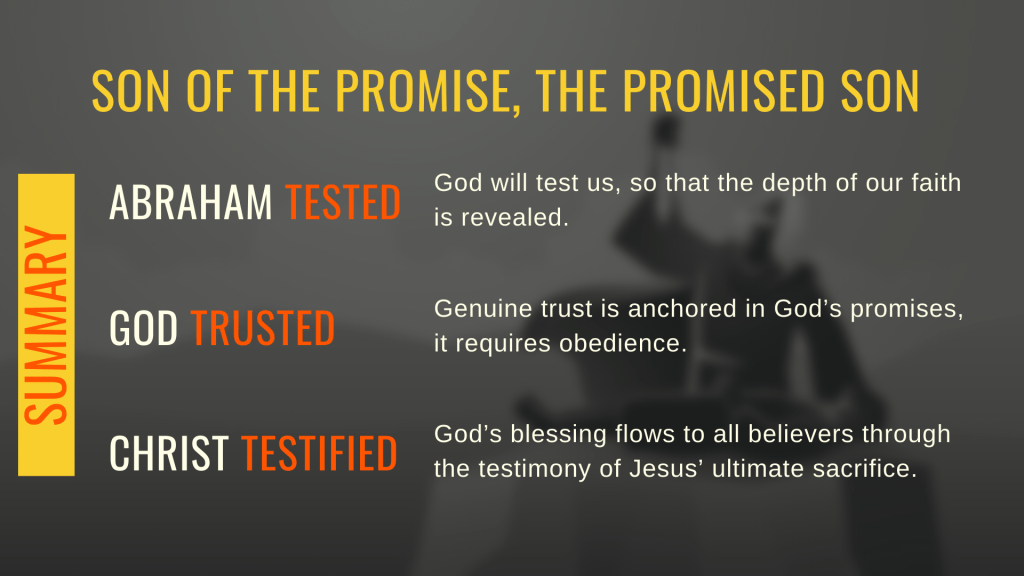
Principle 1: God will test us, so that the depth of our faith is revealed.
When God tests His children, His purpose is to prove that our faith is real. Not that God needs to prove it to Himself since He knows all things, but He is proving to us that our faith is real, that we are truly His children, and that no trial will overcome our faith. When we experience the test and storms of life, we should have an anchor both sure and steadfast. We must “anchor ourselves” more deeply into God’s Word and cling to His promises so we can weather whatever storms come against us.
The test of life we undergo come in various ways. Becoming a Christian will often require us to move out of our comfort zones and into the unknown. Perseverance in testing reveals the depth of our love for God, but more importantly, it results in spiritual maturity and completeness. This is why James wrote, “Consider it pure joy, my brothers, whenever you face trials of many kinds” (James 1:2). When God tests you, it means that He is not done with you. Which brings me to my next point.
God Trusted
I want us to observe Abraham’s response is verse 3:
Abraham rose early in the morning, saddled his donkey, took two of his young men with him, and his son Isaac. He cut the wood for the burnt offering and arose and went to the place of which God had told him.
Genesis 22:6
God never told Abraham why he need to offer Isaac as a burnt offering. Yet, we don’t see any “wait ah…” or “why ah…” from Abraham. God offered no reason, yet all we know is that in this extremely brutal test, Abraham went and prepared everything he needed in order to fulfil what God has just instructed.
Put me in Abraham’s shoes, I would say, “God, I report sick tomorrow. Can I take an MC, huh?” Basically, I’ll say, “Can I drag this out? Can I postpone this? I … I can’t really get to it immediately. I hope you understand, God. Do you want to think this through again?”. I don’t read of Abraham debating at all, and I don’t read of Abraham delaying at all. “Abraham rose early in the morning.” Abraham understood what obedience and trust is all about – no debate, no delay. He got all the stuff ready, and off “he went to the place of which God had told him.”
When there is something you really really don’t want to do, you drag your feet and wait it out for as long as possible. Those of you in the army. When your superior tells you that the book-in timing is at 10pm at night, do you book in at 7pm? No! Unless you really like being in camp, no one will go in so early, you will drag it out till the last possible moment. But we don’t see that from Abraham. God gave the instructions, Abraham was out the door early in the morning. Obedience is no debate, no delay. That is what Abraham had exemplified! He trusted God enough, even though he has not figured out why. He can’t understand why, he doesn’t see how this would fit into the overall picture of God’s promise, but he obeyed God right away. This is obedience. Abraham trusted God. The narrative continues in verse 4-5, (fun fact 2, this is the first time worship appears in the Bible.)
On the third day Abraham lifted up his eyes and saw the place from afar. Then Abraham said to his young men, “Stay here with the donkey; I and the boy will go over there and worship and come again to you.
“Then, Isaac said to his father Abraham, “My father!” And he said, “Here I am, my son.” He said, “Behold, the fire and the wood, but where is the lamb for a burnt offering?” Abraham said, “God will provide for himself the lamb for a burnt offering, my son.” So they went both of them together. Abraham and Isaac went out from the place towards the mountain at Moriah, and there, Abraham laid Isaac on the altar ready for sacrifice.
Genesis 22:4-5, 7-9
What must be going through the mind of Abraham at this point? Well, we don’t need to guess, because in Hebrews 11:19, “He (Abraham) considered that God was able even to raise him (Isaac) from the dead, from which, figuratively speaking, he did receive him back.”. Abraham was so sure that even if God did not provide the lamb for the burnt offering, God will raise Isaac from the dead, so that the promise of God and blessing of God can continue to flow through the offspring of Abraham and Isaac. In the NIV translation of verse 5, it is clear in Abraham’s instruction to the two young men on the journey with him, that he and Isaac will return to them.
Not only that, I want us to remember that Isaac is not a young boy. Unlike most pictures you see depicting this scene of the sacrifice (like the one on the screen), Isaac was believed to be in his late teens, maybe even twenties by the time this episode takes place. He is probably strong and, if I may say, stronger than frail old man, Abraham. And it would be, I think, utterly impossible for Abraham to just bind Isaac up like that. Not only is there a measure of faith by Abraham to be willing to sacrifice Isaac, there is also a depth of trust that Isaac has in submitting to his father, and by extension, God.
Principle 2: Genuine trust is anchored in God’s promises, it requires obedience.
We can learn much from Abraham and Isaac. Isaac understood the task, he willingly allowed his father to tie him up and be placed on the altar. Abraham knew God’s promise to him, made almost 50 years prior. Do you remember God’s promise to you? If you don’t remember, I shall take a few verses from the Bible and remind you:
- John 6:37 says: “All those the Father gives me will come to me, and whoever comes to me I will never drive away.” – The promise of salvation.
- Jesus says, “Come, follow me and I will make you fishers of men” in Matthew 4:19. – The promise of transformation.
- Matthew 11:28, we read, “Come to me, all who are weary and burdened, and I will give you rest.” – The promise of rest and renewal.
- John 14:16. “And I will ask the Father, and he will give you another advocate to help you and be with you forever.” – The promise of the Holy Spirit which brings comfort, understanding, inspiration and empowerment.
- “And if I go and prepare a place for you, I will come back and take you to be with me that you also may be where I am” in John 14:3. – The promise of eternity with God.
The more familiar we are with the living Word, given to us through Scriptures, the more we know God’s promise for each of us. This builds our faith and trust in God, giving us a bigger capacity to be obedient. This brings me to my last point.
Christ Testified
With everything hanging in the balance, most crucially God’s channel of blessing through Abraham and Isaac to all creation, God stopped Abraham where it mattered and provided a substitute lamb for the burnt offering. Most preachers will end the story here, but this is the worst place to end the story. I believe that the scriptures in the Old Testament must point to the hope that we have in Jesus, in the New Testament. So, to see where Jesus fits in all of this, we need to continue to read on.
And the angel of the Lord called to Abraham a second time from heaven and said, “By myself I have sworn, declares the Lord, because you have done this and have not withheld your son, your only son, I will surely bless you, and I will surely multiply your offspring as the stars of heaven and as the sand that is on the seashore. And your offspring shall possess the gate of his enemies, and through your offspring shall all the nations of the earth be blessed, because you have obeyed my voice.”
Genesis 22:15-18
God restates his promise to Abraham. This story began with a test of Abraham’s faith, but it ultimately culminates in a statement and testimony about God’s faithfulness – “I will surely bless you and multiply you.” (Genesis 22:17) God is so committed to His promise to bless. And this blessing, as we would eventually come to know, would be through His Son, Jesus Christ. God is saying, “Abraham, through your Offspring shall all the nations of the earth be blessed.” It’s a long-range promise, but it was a promise well fulfilled.
Because 2,000 years after Abraham, in the line of Isaac will be born Jesus into this world. And this Jesus will go to the cross, and by His death and resurrection, He will be the source of blessing for those who would repent and believe in Him.
Youthphoria, as we enter the season of Lent, which starts on Wednesday, we are reminded that just like Isaac, Jesus would be laid on a wooden cross. And there, Jesus like Isaac would be like a sacrifice and indeed become the sacrifice. But unlike Isaac, Jesus will not be spared.
When the Son would say, “My God, My God, why have You forsaken Me.” Can you imagine the agony in the Father when He is the One who have to deal with His Son, who is bearing the sins of the whole world. And on that day when Jesus is on the cross, there is no one who can take His place, there is no other substitute lamb. He would be the One, who will drink from the cup, and bear the full wrath of God, for you and for me. That is the ultimate sacrifice!
Principle 3: God’s blessing flows to all believers through the testimony of Jesus’ ultimate sacrifice.
The near sacrifice of Isaac recorded in Genesis 22 is just a glimpse of what God would do for sinners, like you and me. God would crush His Son. God will indeed lead His Son to the slaughter, so that you and I today, we have our sins forgiven and be reconciled with God.
“God made Jesus, who knew no sin to be sin for us that we might be made the righteousness of God in Him.” (2 Corinthians 5:21). Youthphoria, this is the central story of the Bible. Genesis 22 is a testimony of the ultimate sacrifice that Jesus would suffer on the cross. Isaac was the son of the promise (small s, small p) that God made with Abraham, but it is through the bloodline of the son of the promise that came the Promised Son (capital P, capital S), offered as a sacrifice for us. Jesus is the victorious channel for which God’s promise of blessing is fulfilled, and will always be fulfilled, you can trust Him.
The title of today’s sermon is “Son of the promise, the Promised Son”. It is a reminder to us that while Isaac is the son of the promise (small s, small p) that God made with Abraham, ultimately, it is Jesus who was and is the Promised Son (capital P, capital S) given to all humanity, so that the full, exclusive, and eternal access to God that was revoked at the Garden of Eden can be re-established. No longer does God choose a single person to be the channel of His blessing, but through Jesus Christ, all of us now become that vessel of blessing to all that is around us.
Youthphoria, let us anchor in living hope and promises of God, and abide in the sacrificial love of Jesus Christ, from which we receive the blessings of God.
 Joel Lai's Webpage