
It’s time for eligible Singaporeans to head to the polling booths once again. A once-in-five/six-year event takes place in the middle of a national epidemic. But that is not what I want to talk about today. For the unacquainted, Singapore’s parliamentary elections is unique, in the sense that no other country in the world (that I know of at least, in the modern world), uses the election system that we have.
A group representation constituency (GRC) is a type of electoral division in Singapore in which teams of candidates compete to be elected into parliament as Members of Parliament (MP). When it was first introduced, the GRC scheme was primarily implemented to enshrine minority representation in Parliament, that means, at least one of the MPs in a GRC must be a member of the Malay, Indian or any minority community of Singapore. Secondarily, with larger constituencies, the GRC was economical for town councils, which manage public housing estates. There remain single-seat contest in some constituencies, called single member constituency (SMC).
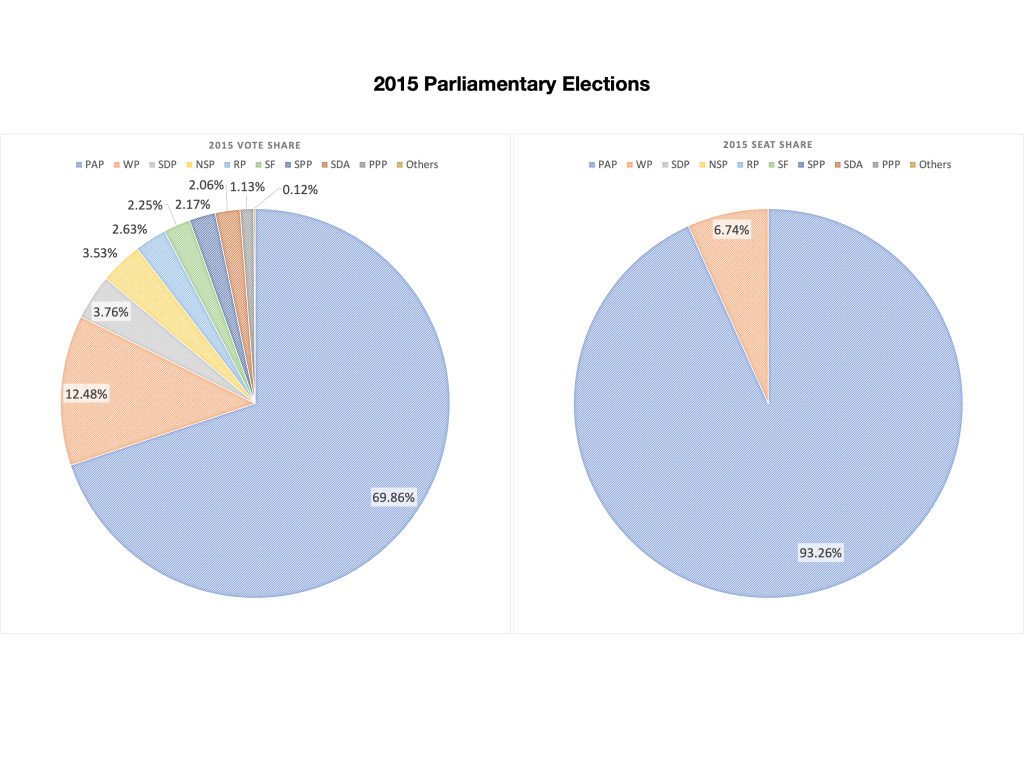
But growing up in Singapore, for as long as I can remember, and probably for as long as any of my parents and grandparents can remember, there is only one party that dominates parliament. Notice that I did not say dominate elections. Sure, there were occasions where they dominated elections, but they always dominated parliament. Let me show you the statistics. Here, we see the results of the past 3 elections, 2015, 2011 and 2006. All seats were contested in 2015; for seats that were not contested in 2011 and 2006, they were not calculated in the vote tally, but counted in the seats acquired.
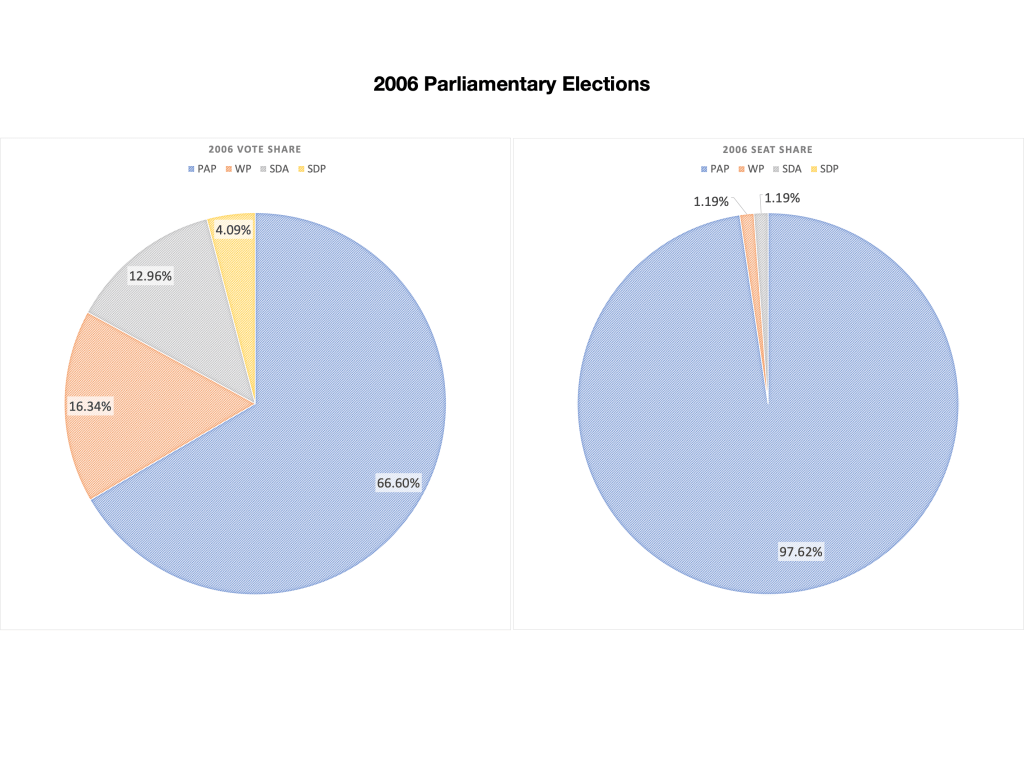
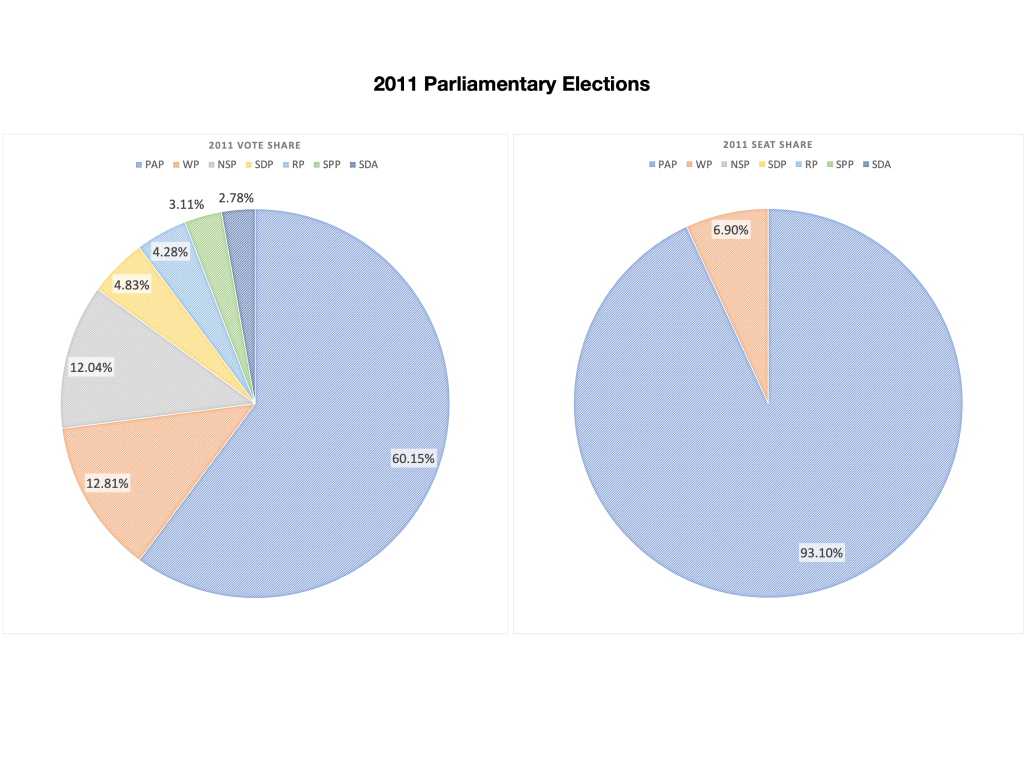
In these three elections, the People’s Action Party (PAP) never won more than 70% of the popular vote, yet in all elections, the PAP held more than 93% of the seats available in parliament. Even if we were to include the Non-constituency Member of Parliaments (NCMP, which is a whole other story for another time), the numbers are highly unrepresentative of the votes of Singaporeans. What are the problems and how can we fix it? I have a few suggestions:
1) First Past The Post voting system
We use first past the post (FPTP) voting. What this means is that the candidate (or team) that gets the most votes in that constituency, wins all the seats available in that constituency. [Now, it is not the fault of the government to use this system of voting, as most democratic nations do so, and frankly, they weren’t the ones that came up with this voting system anyway.] But this voting system is fundamentally flawed because it prevents multi-cornered fights. Consider a hypothetical scenario where a 5-seat GRC is contested between 3 parties: Mouse, Cat and Dog. Mouse wins 30%, Cat wins 34% and Dog wins 36%. Under FPTP, Dog wins 100% of the seats although 64% of the people did not vote for Dog.
Suggestion 1: Do away with FPTP and use the Proportional Representation (PR) system. As the name suggests, the seats in the GRC will be allocated according to proportion of votes casted. Let’s go back to the 3 party fight we saw earlier. Since this is a 5-seat GRC, we calculate the proportion of seats that each of the parties will will. In this case, Mouse wins 0.30*5=1.5 seats, Cat wins 0.34*5=1.7 seats and Dog wins 0.36*5=1.8 seats. But of course, what does decimal seats even mean? So we do some rounding. Starting from the highest proportion, we round to the nearest whole number that does not exceed to the total allocated seats. Since Dog wins 1.8 seats, we round that to the nearest whole number: 2. Next, we look at Cat, Cat also wins 2 seats. Lastly, for Mouse, because this is a 5-seat GRC, and there is only 1 seat remaining, Mouse wins 1 seat.
What this means is that Dog, wins 40% of the seats, Cat also wins 40% of the seats and Mouse wins 20%, pretty proportional to the way the votes are casted. With more GRCs and more parties involved, this system becomes more representative.
Now, you probably can identify some problems here. But, parties run in groups of 5, so if Dog only gets 2 seats, who, out of the 5, gets the 2 seats? This brings me to problem 2.
2) Talents that do not make it to Parliament
GE2020 has revealed a lot of good talents that Singaporeans want in parliament, I name Jamus and Nicole as two from Workers’ Party, of course there are many others. Then there is also the problem of weak candidates being tagged along with ministers, hoping to make their way into parliament because they are protected by the GRC system. [Fun fact: Prior to the 2020 elections, no new candidate has contested in an SMC.] We are bringing in unproven people and kicking out talented ones. How do we fix this?
Suggestion 2: Ranked Lists. It’s that simple. Each GRC will have to produce a list, ranking the order in which the candidates are admitted into Parliament. Let me give an example again. Suppose, representing the Dog party are the following candidates: Bull, Shepherd, Poodle, Labrador and Golden. On Nomination day, other than submitting the names for nomination, the party must also submit the ranking of members. Say ranked from first to last is Golden, Poodle, Bull, Shepherd and Labrador. Then the 2 seats that Dog won, will go to Golden and Poodle. Cat and Mouse will submit their list of ranked names, so that the best from the list gets admitted into Parliament, we have the best ones from each party in parliament and cut out the not so good ones.
How do we ensure that the initial intent of the GRC system continues to be enshrined in our voting system?
Suggestion 3: Abolish SMCs. For people requesting that we abolish GRCs and convert all of them to SMCs, there are problems with that too. Firstly, every SMC contest on a FPTP system, majority wins, representation is not possible. Secondly, in the history of Singapore, only 2 parties have ever won SMC fights. Thirdly, minority representation. I know that there are talks about how the GRC system gives a false sense of achievement for minority races. In particular, the scheme emphasizes racial consciousness and hence widens the gap between races. It may undermine the esteem of minority candidates as they would not be sure if they are elected on their own merit, or due to the scheme and the merits of the rest of the team of MPs. BUT, so far, at least from my numerous interactions with MPs of minority races, they are more capable than the average MP. So while it is a valid point, I’m not quite sure if it has reached the tipping point just yet. But I digress, this is a conversation for another time. How then do we ensure minority representation in the system of PR?
Suggestion 4: The party that wins the most votes in the constituency, must leave a seat for the minority member. What that means is that in our previous example, suppose Bull is the minority member, then, Poodle does not enter parliament, but Bull does. This does not deviate away from ensuring minority representation in the current system and ensures that the majority party walks the talk. Of course, Cat and Mouse can rank their minority candidate in first place, then we have 3 MPs from the minority races and 2 MPs from the majority, that’s perfectly fine as well.
Hypothetically, if we were to conduct such an election in 2015, how will our parliament look like? I have churn the numbers, and the proportion of seats now look like this:
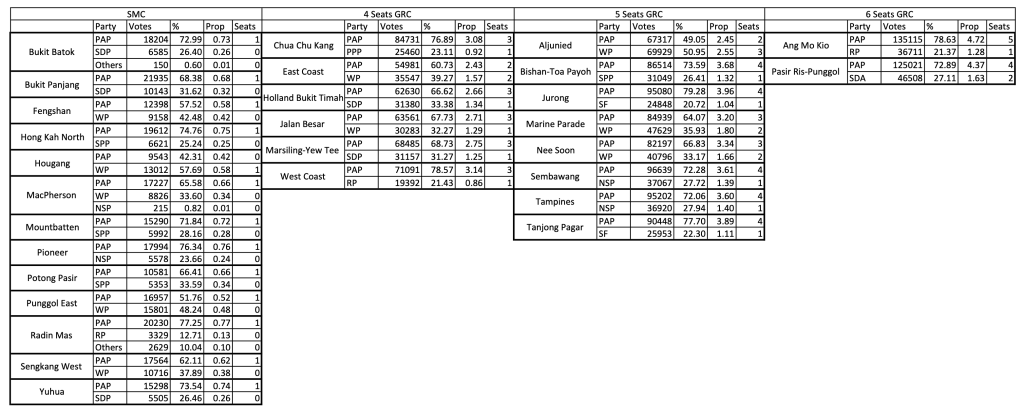
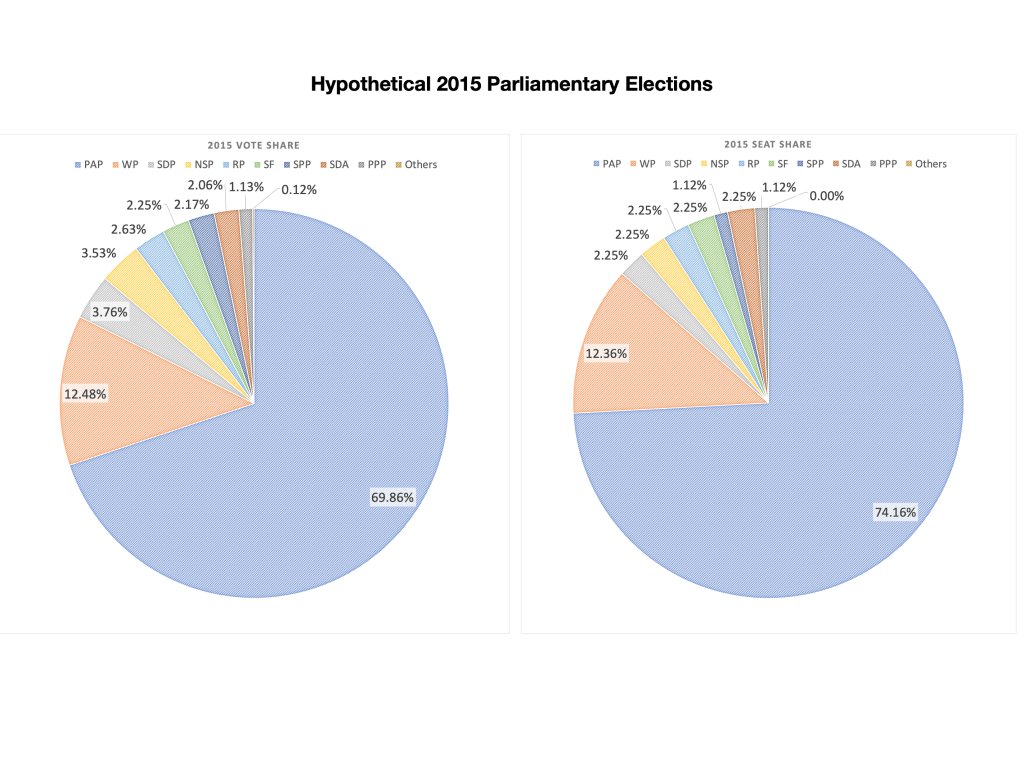
Quite representative of how Singaporeans voted, with PAP tipping past the supermajority, only because of SMC seats. Now, imagine an election like 2011, where PAP only won 2/3 of the votes, but they do not have SMCs to capitalise, multi-corner fights are not uncommon, we use Proportional Representation instead of First Past the Post. Our Parliament will look very different indeed.
Disclaimer: The figures were checked and verified to the best of my ability. Any mistakes are regrettable, but the message of this article remains unchanged. Also, I’m not a political science major, this is all but a thought experiment. Take it however you want.
 Joel Lai's Webpage
2 thoughts on “GE2020: Unrepresentative Democracy (I)”